It's Independence Day here in the US, the day on which we both perpetrate and endure many platitudes about democracy while in fact we continue to erode politically the very cultural narrative (populism, progress, pursuit of happiness) that the holiday is meant to celebrate. Just sayin'. But happy Fourth! 今晩は花火ですね—"fire flowers" this evening. Tomorrow tea practice with a friend and, later, 日本語のレッスン, and then on Friday 休み and then Tanabata 七夕祭り in Fairmount Park. Hopefully, tea class on Saturday and 習字 on Saturday or Sunday. Then, on the 14th, Bastille Day, which we celebrate with much enthusiasm here in Philadelphia (which considers itself the "sister city" to Paris; our own Ben Franklin was ambassador and, it seems, rather a rake).* A good time will, undoubtedly, be had by all. 夏の祭りは大変楽しいと思いますね。酷く楽しいでしょうね。(笑) ガハハ
今朝習字を練習してみましたよ。 I did some writing practice this morning, first 俳句 and 習字 (行書で「澄懐」) and then, in honor of the day, 独立 (dokuritsu, "independence" but, more literally, "standing alone"**) and 自由 (jiyuu, "liberty", but because it derives from 自 self + 由 rationale I like to think of it as "thinking/choosing for oneself"). My holiday writing wasn't very good, but I'm giving myself a by for household ephemera. (Is "give a by" the phrase? 英語はアメリカ人にもときどきちょっと難しいと思いますね.***)
Tonight in theory I am at an event but really I'd rather continue trying to read and translate the rest of the summer haiku from 「俳句編」.
I discovered today that we have a giant Asian grocery store right here in Center City—which is great because it means I can get some things I need for tea without taking buses or trains. I was looking for wagashi for tea tomorrow, and though I didn't find what I really wanted (artisanal wagashi—not likely this side of New York), I found some 良さそうな抹茶, macha that looks like it'll work at least for usucha, and then various okashi and lots of random things that I'm just looking forward to exploring. (I've never in my life had an entire fish in my freezer, but a milkfish resides there now.)
本当に夏になっていますね。
*The tradition here for the Quatorze is to have someone dress as
Marie-Antoinette and toss Twinkies or some substitute ("qu'ils mangent
de la brioche", which probably she did not in fact say) from the ramparts of Eastern State Penitentiary, which is the closest building we have to the Bastille.
**ですが。。。「独」というのはね。Per Henshall, 独 derives from kemono-hen, the (wild) dog radical, and a caterpillar, formerly written as 属 (and older forms) but now written as the indefatigable mushi 虫, generic insectness. Dog and caterpillar together came to mean unity, fighting for a single cause (which would be what, exactly?) and then, eventually, singularity. It also means Germany; I can't even begin to engage that.
***In saying this I'm making a reference to an interesting point that bikenglishさん made in his blog, about problems with prepositions when they refer to unusual physical situations—behind the yellow line? below it? beneath it? In the train, or on it? (When I was studying literary critical theory we'd have thought of it as intertextuality.) Last week at 習字 we read a little from the 古今和歌集, to practice reading hentaigana, so since then I've been thinking about 本歌取り honkadori, the poetic practice of alluding to a classical poem, in order to both demonstrate erudition and link one's own work to a larger tradition. I wrote something about it, I think, involving Sosei and 袖ひちて むすびし水の こほれるを 春立つ今日の 風やとくらむ dipping kimono sleeves in freezing water and 春たてば 花とやみらん白雪の かゝれる枝に うぐひすのなく nightingales on branches in the remaining spring snow, and Princess Shikishi waiting in vain for her lover, but it seems that I now have more drafts than actual posts. Story of my life!
Wednesday, July 4, 2012


Sunday, July 1, 2012
Haiku; Ootsubukuro (repaired).
(Blogger decided to delete this one. Yay.)
I don't know why I have haiku on the brain these days, but I do. Yesterday at tea class, we could hear a waterfall in the pond and a frog croaking, so, naturally,
Anyway. In tea class yesterday we did usucha and then koicha, a new-to-me temae called Ootsubukuro in which the natsume is wrapped in not the fukusa but a bag similar to bags formerly used to carry grain from Ootsu to Kyouto (about 7 miles away). Apparently Rikyuu's wife made the first Ootsubukuro and Rikyuu developed the style. Me, I'm eagerly awaiting 洗い茶巾 araijakin season (July and August); the temae that emphasizes the sound of water—beautiful, and perfect for the summer.
I don't know why I have haiku on the brain these days, but I do. Yesterday at tea class, we could hear a waterfall in the pond and a frog croaking, so, naturally,
古池 / 蛙飛び込む / 水の音And when a fly buzzed in cavalierly and circled the tray of お菓子 tea sweets,
furu ike ni kawazu tobikomu mizu no oto
Into the old pond the frog jumps—sound of the water (or: splash!)
Bashou, 1686
塗盆を蝿が雪隠にしたりけりAnd then, when as I was walking home it rained on me,
nuribon o hae ga secchin ni shitari keri
the fly makes the lacquer tray a bathroom
Issa, 1824
着ながらにせんだくしたり夏の雨This morning when I came downstairs I met a cockroach, who was investigating the running clothes that I'd thrown on the floor yesterday. (My house is 200+ years old, so such encounters do happen from time to time.) He perked up when I entered the room, and then we looked at each other for a few seconds; then I picked up a binder of legal opinions that happened to be nearby and smashed him. As I learned yesterday, Issa, who practiced 浄土仏教 "Pure Land" Buddhism, also thought about the ethics of killing insects:
kinagara ni sentaku shitari natsu no ame
washing my clothes while wearing them—summer rain
Issa, 1821
蝿打てけふも聞也山の鐘In fact Issa wrote quite a few poems about swatting things. (Then again, as Issa wrote about 20,000 haiku, there probably are quite a few about anything!)
hae uchite kefu (kyou) mo kikunari yama no kane
swatting a fly, today again I hear the mountain (temple) bell
1806
蠅打に敲かれ玉ふ仏哉
hae uchi ni tatakare tamau hotoke kana
in swatting a fly, hitting the Buddha
1808
蝿一つ打てはなむあみだ仏哉
hae hitotsu utte wa namu amida butsu kana
swatting a single fly—praise to Amida Buddha!
1814
蝿打やあみだ如来の御天窓
hae utsu ya amida nyorai no onatama
swatting a fly—Amida Buddha's holy head
1815
(D Lanoue's translation of "holy head"; 御天窓 might also be otenmado, but I'm sure it has specific meanings and he's reading it correctly.)
やれ打な蝿が手をすり足をする
yare utsuna hae ga te wo suriashi o suru
don't swat the fly! he's rubbing his feet together [as if in prayer]
1821
Anyway. In tea class yesterday we did usucha and then koicha, a new-to-me temae called Ootsubukuro in which the natsume is wrapped in not the fukusa but a bag similar to bags formerly used to carry grain from Ootsu to Kyouto (about 7 miles away). Apparently Rikyuu's wife made the first Ootsubukuro and Rikyuu developed the style. Me, I'm eagerly awaiting 洗い茶巾 araijakin season (July and August); the temae that emphasizes the sound of water—beautiful, and perfect for the summer.
蝿; 挨拶.
So yesterday, when that fly appeared and buzzed around the tea sweets, I made up a lame haiku about it:
Aisatsu is the formal bow/greeting before tea class, in which one asks the teacher for a lesson (and the guests for their patience). It's done when one has barely entered the room, when the feet are just past the threshold. The fukusa isn't yet tucked into the obi, because it's possible that the teacher will decline to give you a lesson; only if the teacher agrees can you return to the mizuya and gear up to make tea.
The fly entered the room without aisatsu, so no sweets for him!
蝿様もお菓子の前に挨拶ね(I'm pretty sure the grammar is wrong, but it's tough with haiku, and anyway that's what occurred to me.)
hae sama mo okashi no mae ni aisatsu ne
even for you, Lord Fly, before the sweets, aisatsu
Aisatsu is the formal bow/greeting before tea class, in which one asks the teacher for a lesson (and the guests for their patience). It's done when one has barely entered the room, when the feet are just past the threshold. The fukusa isn't yet tucked into the obi, because it's possible that the teacher will decline to give you a lesson; only if the teacher agrees can you return to the mizuya and gear up to make tea.
The fly entered the room without aisatsu, so no sweets for him!
Friday, June 29, 2012
Radical, tragic Shiki.
Reading up a little on Issa's life has me thinking about another of the four haiku masters, MASAOKA Shiki (who lived much later than the other three, 1867–1902—note that he died at the young age of 35). He's a fascinating figure, and the more I read about him the more interesting I find him. He was from samurai stock but by his teens, in school (in the early 1880s), he was so strongly in favor of elections, civil rights, etc., that the school actually banned him from speaking in public (ca. 1882), as a pro-democracy radical:
What's particularly poignant about Shikiさん, amazing as he was, is that he suffered from tuberculosis for much of his life. He was coughing up blood for about the last thirteen years and was bed-bound for the last five. (The source of his poetic name, Shiki, is the cuckoo ほととぎす, which is traditionally held to cough blood as it sings—at least, that's what I've read.) Last week at shuuji 先生 was kind enough to show me some of Shiki's writing, three poems on one page, written at different angles; 先生 said he probably was lying on his left side while writing. So, he may have lost some functioning before then. Beyond sad.
(Did I mention that, in addition to being one of the four great masters of haiku, Shikiさん went to China as a war correspondent in the Sino-Japanese War of 1894–1895 and also is in Japan's Baseball Hall of Fame? We all should achieve so much in so little time!)
Fun fact: Shikiさん was a fellow middle-school student and friend of the novelist NATSUME Souseki, who also wrote haiku, and encouraged him in his writing. (Natsume wrote 坊っちゃん about his experience teaching there some twelve years after Shiki moved to Toukyou.) Apparently the government sent Natsume to study in England from 1901–1903 as Japan's first British literary scholar; since the UK census is conducted every ten years on the '01s, I checked the 1901 census for Natsume, and there he is! At #6, Flodden Road, Lambeth, K Natsume—he was born 金之助 Kinnosuke; Souseki was a pen name taken from his Chinese studies—34, Japanese, married, an instructor of literature. (Presumably his wife, Kyouko, was still in Japan.) Natsume later said that he'd pretty much hated his time in England and had felt alienated by British people. Interesting that there also was, boarding in that house, a Japanese merchant, TANAKA Kotarou. I wonder whether they'd known each other earlier in life—or, if not, why this boarding house would unusually be hosting two Japanese citizens, as there were only about 800 Japanese-born people in all of London at the time, and most of them were ancestrally British.
*I feel silly spelling "Tokyo" that way, but the difference between long and short vowels really is an important one, especially for students, like me; 日本語で they're written differently. So I'm going to be rigorous about it and transliterate things as faithfully as I can.
In the 1870s and 1880s, the democratic movement was at its height, and one of its chief leaders was Taisuke Itagaki (1837–1919) from Kochi Prefecture... [...] [D]emocratic thought reigned at the school; yet after the principal's departure many students left, and their numbers decreased from 213 in 1879 to 102 in 1881. Among those strongly influenced by the former principal was Shiki. He neglected most of his schoolwork, so caught up was he in the excitement of making political speeches night after night with ten or so of his classmates. (source)面白いですね。In the 1880s and 1890s he became a kind of poetry radical, intentionally picking up forms that were in decline in the 明治時代 Meiji era (specifically, haiku and tanka), dropping out of college to do so, and focusing on poetic reform. (What reforms he wanted, exactly, I don't yet know.) Late in his life he had a circle of acolytes and left Matsuyama for Toukyou.*
What's particularly poignant about Shikiさん, amazing as he was, is that he suffered from tuberculosis for much of his life. He was coughing up blood for about the last thirteen years and was bed-bound for the last five. (The source of his poetic name, Shiki, is the cuckoo ほととぎす, which is traditionally held to cough blood as it sings—at least, that's what I've read.) Last week at shuuji 先生 was kind enough to show me some of Shiki's writing, three poems on one page, written at different angles; 先生 said he probably was lying on his left side while writing. So, he may have lost some functioning before then. Beyond sad.
(Did I mention that, in addition to being one of the four great masters of haiku, Shikiさん went to China as a war correspondent in the Sino-Japanese War of 1894–1895 and also is in Japan's Baseball Hall of Fame? We all should achieve so much in so little time!)
Fun fact: Shikiさん was a fellow middle-school student and friend of the novelist NATSUME Souseki, who also wrote haiku, and encouraged him in his writing. (Natsume wrote 坊っちゃん about his experience teaching there some twelve years after Shiki moved to Toukyou.) Apparently the government sent Natsume to study in England from 1901–1903 as Japan's first British literary scholar; since the UK census is conducted every ten years on the '01s, I checked the 1901 census for Natsume, and there he is! At #6, Flodden Road, Lambeth, K Natsume—he was born 金之助 Kinnosuke; Souseki was a pen name taken from his Chinese studies—34, Japanese, married, an instructor of literature. (Presumably his wife, Kyouko, was still in Japan.) Natsume later said that he'd pretty much hated his time in England and had felt alienated by British people. Interesting that there also was, boarding in that house, a Japanese merchant, TANAKA Kotarou. I wonder whether they'd known each other earlier in life—or, if not, why this boarding house would unusually be hosting two Japanese citizens, as there were only about 800 Japanese-born people in all of London at the time, and most of them were ancestrally British.
*I feel silly spelling "Tokyo" that way, but the difference between long and short vowels really is an important one, especially for students, like me; 日本語で they're written differently. So I'm going to be rigorous about it and transliterate things as faithfully as I can.
親のない雀 (Issa's rough life).
On Market Street this afternoon I saw a little sparrow, who presumably was looking for somewhere to enjoy a morsel that he had in his beak, repeatedly try to fly through a glass wall before giving up and winging goofily down the street. A bit later I saw him again, just standing there, looking confused. So I said to him,
我と来て 遊べや 親のない雀—which amused me because it's the poem (by Issa) that we're currently working on in shuuji. What satisfaction, to have an à propos haiku on hand for such occasions! すごく有名な句だそうです。(In shuuji we're writing the poem on tanzaku, with some interesting hentaigana: 我と来天 遊へ矢 親能ない雀.)
ware to kite asobe ya oya no nai suzume
come and play with me, orphan sparrow
Haiku and Issa expert David G. Lanoue informs us that Issa wrote this poem in a journal in his early fifties, recounting an incident that happened when he was six. He revised it slightly five years later, changing only the form of asobu, "to play": 我と来て遊ぶや ("coming to play with me") in 1814 and then 我と来て遊べや ("come and play with me") in 1819. Apparently the command form is more popular now, but after a while it does start to sound a little stalky—until we realize that Issa himself was a kind of oya no nai suzume. His mother died when he was three, other kids mocked and ostracized him for being motherless, and then the grandmother he'd been living with died when he was fourteen, and then he didn't get along with his father's new family and at fifteen was kicked out to Toukyou to find work. (In later life he married three times, all his children died, he battled his stepmother for his inheritance, he fell into debt, and his house burned down. Pretty emo guy, all around.)
Looks like Issa wrote quite a few more 句 about sparrows and broken families:
(all below are from Lanoue's excellent Issa Archive, searched thusly)
Interesting that he usually uses ままこ or ままっこ for "stepchild" but also uses 義理のある子, "debt/obligation child". Issa also wrote some poems about stunted growth in plants trapped in the shade of larger things. (One of them Lanoue mentions, in the shadow of 鬼婆山 "(W)itch Mountain", I'd love to find, but no luck so far.) I think that's the essence of haiku: a moment that's superficially simple but expresses larger themes (or deeper truths). Still waters that run deep.夕暮や親なし雀何と鳴yûgure ya oya nashi suzume nanto nakuevening—how the orphan sparrowcries!(1810)むつまじき二親もちし雀哉mutsumajiki futaoya mochishi suzume kanaliving in harmony—the sparrow hasboth parents!(1810)鳴よ鳴よ親なし雀おとなしき
nake yo nake yo oya [na]shi suzume otonashikising, sing!orphan sparrow...so quiet(1810)夕暮とや雀のまま子松に鳴yûgure to ya suzume no mamako matsu ni nakuevening falls—a stepchild sparrowcries in the pine(1811)親雀子雀山もいさむぞよoya suzume ko suzume yama mo isamu zo yoparent sparrowsbaby sparrows...a happy mountain(1812)雀子や親のけん嘩をしらぬ顔suzumego ya oya no ken[ka] wo shiranu kaobaby sparrow—his face unawareof his parents' fights(1812)かはるがはる巣の番したり親雀kawaru-gawaru su no ban shitari oya suzumetaking turnsguarding the nest...parent sparrows(1813)雀子を遊ばせておく畳哉suzumego wo asobasete oku tatami kanathe baby sparrowis allowed to play...tatami mat(1813)親のない一つ雀のふとりけりoya no nai hitotsu suzume no futori kerithe lone orphan sparrowniceand plump(1814)むら雀さらにまま子はなかりけりmura suzume sara ni mamako wa nakari keriflock of sparrows—and not one of thema stepchild(1814)しよんぼりと雀にさへもまま子哉shonbori to suzume ni sae mo mamako kanadejected—even among sparrowsa stepchild(1818)ぎりのある子を呼ばるかよ夕雀giri no aru ko wo yobaru ka yo yû suzumeare you callingfor your stepchild?evening sparrow(1819)
竹ぎれで手習ひをするまま子哉
takegire de tenarai [wo] suru mamako kana
with a bamboo splinter
practicing calligraphy...
the stepchild
(1816)
Thursday, June 7, 2012
夏についての句。 (Summer haiku!)
Now that summer is officially upon us—well, as of a month ago in kigo time—it's just about time to wish a fond sayounara to the stone bridge–and–camellias tanka I've been working on and move back to summer themes. (椿 tsubaki, camellias, are a spring theme; the kanji radicals are literally tree + spring.) So, below is a stab at some haiku from a book that 習字の先生 gave us. The book divides them by period of summer, according to the old lunar calendar (officially out of use since 1873 but well worth reading about).
初夏
shoka (or, more amusingly, hatsunatsu)
early summer
心ここになきかなかぬか時鳥
kokoro koko ni naki ka nakanu ka hototogisu
cuckoo, is your mind on your singing, or not?
井原西鹤—IHARA Saikaku (aka Kakuei) (1642–1693)
ノート: Pun/witticism on the phrase "kokoro koko ni arazu" (心ここに有らず), to be distracted or not fully paying attention to the task at hand. from Chinese 心不在焉,視而不見,聴而不聞 (rendered in Japanese as 心焉ニ在ラザレバ、視レドモ見エズ、聴ケドモ聞コエズ—kokoro koko ni arazareba, miredo mo miezu, kikedo mo kikoezu "if you're not paying attention (if your mind/heart "isn't in residence"), you can look (視) but not see (見), listen (聴) but not hear (聞)". Or, maybe: "though one may look, [it] is not visible; though one may listen, [it] can't be heard". The book's editor suggests (I think) that the poet is wondering whether the reason why he can't hear the cuckoo is that the bird is singing carelessly (and thus can't be heard), or that the bird isn't singing at all. Interestingly, Ihara seems to have been at the vanguard of the literary tradition of (bawdy) stories of town merchants that developed into the ukiyo ("floating world") aesthetic that's now so closely identified with woodblock prints (Hiroshige, Hokusai, etc.). I've been reading one of his books.
時鳥いかに鬼神もたしかに聞け
hototogisu ika ni kijin mo tashika ni kike
the cuckoo's calling—angry gods, listen up!
西山宗因—NISHIYAMA Souin (1605–1682)
ノート (from the book):This "ika ni" (以下に) is borrowed from the Noh play "田村" (Tamura) and is often seen ("見れらる"—typo in the book?) in old haiku. (I looked at the text of Tamura and did find a mention of an angry/fierce god [鬼神]—"a roar of a demon, shaking rivers and mountains, echoed in the sky and filled the earth..." but nothing in its context that justifies いか beyond the sense of "below".) (Nishiyama is associated with the Danrin "laughing forest" haiku style, lighter and wittier than the "bookishness" [e.g., Bashou's] that was otherwise popular at the time. Apparently, Nishiyama studied with Bashou but then went back to his own style. Ihara above was his student.)
Correction: "ika ni" is 如何に—how, how much, etc.
目には青葉山時鳥初鰹
me ni ha ooba yama hototogisu hatsugatsuo
before my eyes, fresh leaves, mountain cuckoo—season's first bonito
山口素堂—YAMAGUCHI Sodou (1642–1716)
Per the book's notes, first-bonito is a specialty in Kamakura. Apparently they usually show up in fish markets in May, the first catch released for sale (by law) on the first day of the fourth month of the lunar calendar. ("Hatsugatsuo" has furigana in the book, but the last character is を, not お. ?!)
閑かさや岩にしみ入る蝉の聲
shizukasa ya iwa ni shimihairu semi no koe
silence—the cicada's voice pierces the rocks
松尾芭蕉—MATSUO Bashou (1644–1694)
Book's note: This isn't the midsummer locust (盛夏の蝉), but the early locust. (The editor knows this how?) (Note that the book uses what I think must be an older form of semi, with two 口 at top right. Henshall doesn't list it.)
五月雨を集めて早し最上川
samidare o atsumete hayashi mogamigaha
uppermost river (?), collecting early-summer rain
松尾芭蕉—MATSUO Bashou (1644–1694)
うき我を淋しがらせよかんこ鳥
uki ware o sabishigaraseyo kankodori
make me lonelier, sake cup—cuckoo
松尾芭蕉—MATSUO Bashou (1644–1694)
Book's ノート: The cuckoo has (also) been called "kankodori" since long ago. This is a haiku about living alone and is famous for its "sabi" feel. (The aesthetic concept of sabi is hugely important, though to me still obscure; in tea specifically, it refers to the sheen, slight damage, etc., that things—tea bowls, etc.—acquire with years of use; desirable. But the kanji is the same as for loneliness, 寂しさ, so it also has a sense of poignancy, impermanence, isolation.) (See also this, about Bashou, Li Po, and the poet's three friends: moon, shadow, and sake cup. Raising the cup, we greet the bright moon / With my shadow we become three.)
清瀧の水くみよせてところてん
sayataki (??) no mizu kumiyosete tokoro ten
(This one stumps me. Something about water collecting from the pure/clear/bright waterfall, and then some kind of ooze? To borrow a phrase from 上級へのとびら, 分かんないなぁ。。。。)
松尾芭蕉—MATSUO Bashou (1644–1694)
Many more, but for now.
初夏
shoka (or, more amusingly, hatsunatsu)
early summer
心ここになきかなかぬか時鳥
kokoro koko ni naki ka nakanu ka hototogisu
cuckoo, is your mind on your singing, or not?
井原西鹤—IHARA Saikaku (aka Kakuei) (1642–1693)
ノート: Pun/witticism on the phrase "kokoro koko ni arazu" (心ここに有らず), to be distracted or not fully paying attention to the task at hand. from Chinese 心不在焉,視而不見,聴而不聞 (rendered in Japanese as 心焉ニ在ラザレバ、視レドモ見エズ、聴ケドモ聞コエズ—kokoro koko ni arazareba, miredo mo miezu, kikedo mo kikoezu "if you're not paying attention (if your mind/heart "isn't in residence"), you can look (視) but not see (見), listen (聴) but not hear (聞)". Or, maybe: "though one may look, [it] is not visible; though one may listen, [it] can't be heard". The book's editor suggests (I think) that the poet is wondering whether the reason why he can't hear the cuckoo is that the bird is singing carelessly (and thus can't be heard), or that the bird isn't singing at all. Interestingly, Ihara seems to have been at the vanguard of the literary tradition of (bawdy) stories of town merchants that developed into the ukiyo ("floating world") aesthetic that's now so closely identified with woodblock prints (Hiroshige, Hokusai, etc.). I've been reading one of his books.
時鳥いかに鬼神もたしかに聞け
hototogisu ika ni kijin mo tashika ni kike
the cuckoo's calling—angry gods, listen up!
西山宗因—NISHIYAMA Souin (1605–1682)
ノート (from the book):This "ika ni" (以下に) is borrowed from the Noh play "田村" (Tamura) and is often seen ("見れらる"—typo in the book?) in old haiku. (I looked at the text of Tamura and did find a mention of an angry/fierce god [鬼神]—"a roar of a demon, shaking rivers and mountains, echoed in the sky and filled the earth..." but nothing in its context that justifies いか beyond the sense of "below".) (Nishiyama is associated with the Danrin "laughing forest" haiku style, lighter and wittier than the "bookishness" [e.g., Bashou's] that was otherwise popular at the time. Apparently, Nishiyama studied with Bashou but then went back to his own style. Ihara above was his student.)
Correction: "ika ni" is 如何に—how, how much, etc.
目には青葉山時鳥初鰹
me ni ha ooba yama hototogisu hatsugatsuo
before my eyes, fresh leaves, mountain cuckoo—season's first bonito
山口素堂—YAMAGUCHI Sodou (1642–1716)
Per the book's notes, first-bonito is a specialty in Kamakura. Apparently they usually show up in fish markets in May, the first catch released for sale (by law) on the first day of the fourth month of the lunar calendar. ("Hatsugatsuo" has furigana in the book, but the last character is を, not お. ?!)
閑かさや岩にしみ入る蝉の聲
shizukasa ya iwa ni shimihairu semi no koe
silence—the cicada's voice pierces the rocks
松尾芭蕉—MATSUO Bashou (1644–1694)
Book's note: This isn't the midsummer locust (盛夏の蝉), but the early locust. (The editor knows this how?) (Note that the book uses what I think must be an older form of semi, with two 口 at top right. Henshall doesn't list it.)
五月雨を集めて早し最上川
samidare o atsumete hayashi mogamigaha
uppermost river (?), collecting early-summer rain
松尾芭蕉—MATSUO Bashou (1644–1694)
うき我を淋しがらせよかんこ鳥
uki ware o sabishigaraseyo kankodori
make me lonelier, sake cup—cuckoo
松尾芭蕉—MATSUO Bashou (1644–1694)
Book's ノート: The cuckoo has (also) been called "kankodori" since long ago. This is a haiku about living alone and is famous for its "sabi" feel. (The aesthetic concept of sabi is hugely important, though to me still obscure; in tea specifically, it refers to the sheen, slight damage, etc., that things—tea bowls, etc.—acquire with years of use; desirable. But the kanji is the same as for loneliness, 寂しさ, so it also has a sense of poignancy, impermanence, isolation.) (See also this, about Bashou, Li Po, and the poet's three friends: moon, shadow, and sake cup. Raising the cup, we greet the bright moon / With my shadow we become three.)
清瀧の水くみよせてところてん
sayataki (??) no mizu kumiyosete tokoro ten
(This one stumps me. Something about water collecting from the pure/clear/bright waterfall, and then some kind of ooze? To borrow a phrase from 上級へのとびら, 分かんないなぁ。。。。)
松尾芭蕉—MATSUO Bashou (1644–1694)
Many more, but for now.
Saturday, May 19, 2012
今朝茶の湯のお稽古 (Tea!)
Beautiful tea class today. Sunshine, blue sky, cool breeze, many visitors at Shofuso. We were doing 薄茶 (usucha, thin/weak tea), so as sweets we had delicious
wafer-like cookies called (I think) zenbei*, with a maple-y flavor and a
little outline of a ginkgo leaf on each. We had class in the larger room (書院, 15 mats), rather than in the 4.5-mat 茶室, so I had to recalibrate my walking a bit; went well pretty overall, but I need to practice more over the week so I can be more confident in the flow, especially in お仕舞い (oshimai, closing). My ankle injury made even more clear the contrast between 正座 (seiza, "sitting correctly") and 安座 (anza, "sitting comfortably")—there was no 安 whatsoever in my 正.
The first guest (正客, shoukyaku) really has to be on the ball throughout the event, because, aside from the scripted formalities, the other guests are rarely allowed to speak. After each bowl is returned from the guest to the host and rinsed out, the first guest has to signal to the host whether to make another bowl, to make him-/herself a bowl, or to move on to the closing-up (お仕舞い) activities. The phrase for making a bowl of tea for oneself, when asked to, is one that (I think) is used only in this context: 御自服 (gojifuku, honorific–self–powder/tea). We call it "playing the gojifuku card". Maybe it's just a way of being thoughtful, or maybe it was a way for your enemy, whom you've invited to a formal tea meeting and who now suspects you've just poisoned them with matcha, to make you do the same to yourself. I wonder whether there's a protocol for refusing.
*When I was trying to confirm the word 先生 used for the sweets, Google helpfully suggested I meant "Japanese tea sweet zombie". A few more zenbei, and I could turn into one of those!)
The first guest (正客, shoukyaku) really has to be on the ball throughout the event, because, aside from the scripted formalities, the other guests are rarely allowed to speak. After each bowl is returned from the guest to the host and rinsed out, the first guest has to signal to the host whether to make another bowl, to make him-/herself a bowl, or to move on to the closing-up (お仕舞い) activities. The phrase for making a bowl of tea for oneself, when asked to, is one that (I think) is used only in this context: 御自服 (gojifuku, honorific–self–powder/tea). We call it "playing the gojifuku card". Maybe it's just a way of being thoughtful, or maybe it was a way for your enemy, whom you've invited to a formal tea meeting and who now suspects you've just poisoned them with matcha, to make you do the same to yourself. I wonder whether there's a protocol for refusing.
*When I was trying to confirm the word 先生 used for the sweets, Google helpfully suggested I meant "Japanese tea sweet zombie". A few more zenbei, and I could turn into one of those!)
Wednesday, May 16, 2012
Tobira, Genki, and new resources for students.
日本語のレッスン this evening—yay!—so last night I was rereading the current chapter in the Tobira textbook (上級へのとびら, Gateway to Advanced Japanese), which is the third book we've worked with, after the two Genki (元気) books. Tobira is a pretty big step up from even Genki 2; Genki seems designed for foreign students studying in Japan—先生 said it's probably for Korean students specifically—so it tends to focus on issues (such as majors and host families) that pertain to students more directly than to ancients such as I. Its vocab* is pretty basic and its usage generally normal–polite, and although it covers a good deal of grammar the sentences tend to max out at compound.* Tobira expects much more of the reader; it includes very little English in most areas, more kanji, and much longer and more syntactically and semantically complex sentences. So, Tobira can be frustrating sometimes, at least for me.
For example, a passage I was reading last night on basic speech styles (plain, polite, etc.) includes an (apparently literary) style it calls である体, the "de aru" form. In parentheses it labels this as the "expository" form, but it seems not to explain what it means by "expository", or who or what is being exposed to what or whom and in what context. I've seen this form in essays and literature, so I think I pretty much get it, but it's difficult to be sure.** OK, granted, this isn't a big deal, and overall the book is terrific; but from time to time I do want to (respectfully) wing it across the room. 扉 >> 飛びら。 飛び扉。
でも、頑張りましょうね。
Anyway, today there's good news on the learning-resources front. I've been thinking for a while of coding a quiz app for the Tobira (and other) vocab, like the very helpful one that Usagi-chan made for Genki, but I've been short on time; today I thought maybe I'd try to contact her and, instead of reinventing the wheel, ask for the existing code (and permission to use it) and just populate it with the Tobira content. Still haven't decided on that, but while surfing around about it I discovered this useful page of resources for students of Japanese, which in turn led me to this amazing page of links. Much fun stuff to explore! I also like to flip through 朝日毎日新聞, Goo, and Yahoo.co.jp. (I dutifully read the news and culture stories, but I admit I find the horoscopes and personal ads more fun. I'm still looking for a good online source for daily manga, puzzles, etc.) I've also been trying to get away from "crutches" like the plug-in Rikaichan, which are immensely helpful but which sometimes make things too easy. Tough to find a middle ground between looking up 30-some kanji per page, by radicals (as with a paper novel), and skating over unknown kanji online with a quick pop-up, without taking the time to look at the kanji carefully and get used to them.
*Genki's approach to vocabulary is (from my POV) ちょっと可笑しい; I'm all for situational vocabulary units, but the groupings in Genki tend (1) to be not quite as thorough as one might hope for that context (eg, some airport words, but not all you'll need for that experience) and (2) sometimes to seem random (eg, learning how to express having been regrettably groped in the subway, or how to inform the police about a burglary, before you officially learn tree or socks. What if someone steals your socks?).
**Reminds me of how, when I was learning French in school, my teachers told us we didn't need to learn the passé simple tense, as it was "a literary tense" that we'd never encounter in real life. Probably a reasonable approach for most students, but of course I ended up as a French lit major in college and then grad school. Mais c'est la vie, quoi. しょうがないですね。(「仕方はありません」と言うこともありますかなぁ。Googleでhitsが263千つ(?)あります。「為さい片は御座いません」。。。。へへへ。)
For example, a passage I was reading last night on basic speech styles (plain, polite, etc.) includes an (apparently literary) style it calls である体, the "de aru" form. In parentheses it labels this as the "expository" form, but it seems not to explain what it means by "expository", or who or what is being exposed to what or whom and in what context. I've seen this form in essays and literature, so I think I pretty much get it, but it's difficult to be sure.** OK, granted, this isn't a big deal, and overall the book is terrific; but from time to time I do want to (respectfully) wing it across the room. 扉 >> 飛びら。 飛び扉。
でも、頑張りましょうね。
Anyway, today there's good news on the learning-resources front. I've been thinking for a while of coding a quiz app for the Tobira (and other) vocab, like the very helpful one that Usagi-chan made for Genki, but I've been short on time; today I thought maybe I'd try to contact her and, instead of reinventing the wheel, ask for the existing code (and permission to use it) and just populate it with the Tobira content. Still haven't decided on that, but while surfing around about it I discovered this useful page of resources for students of Japanese, which in turn led me to this amazing page of links. Much fun stuff to explore! I also like to flip through 朝日毎日新聞, Goo, and Yahoo.co.jp. (I dutifully read the news and culture stories, but I admit I find the horoscopes and personal ads more fun. I'm still looking for a good online source for daily manga, puzzles, etc.) I've also been trying to get away from "crutches" like the plug-in Rikaichan, which are immensely helpful but which sometimes make things too easy. Tough to find a middle ground between looking up 30-some kanji per page, by radicals (as with a paper novel), and skating over unknown kanji online with a quick pop-up, without taking the time to look at the kanji carefully and get used to them.
*Genki's approach to vocabulary is (from my POV) ちょっと可笑しい; I'm all for situational vocabulary units, but the groupings in Genki tend (1) to be not quite as thorough as one might hope for that context (eg, some airport words, but not all you'll need for that experience) and (2) sometimes to seem random (eg, learning how to express having been regrettably groped in the subway, or how to inform the police about a burglary, before you officially learn tree or socks. What if someone steals your socks?).
**Reminds me of how, when I was learning French in school, my teachers told us we didn't need to learn the passé simple tense, as it was "a literary tense" that we'd never encounter in real life. Probably a reasonable approach for most students, but of course I ended up as a French lit major in college and then grad school. Mais c'est la vie, quoi. しょうがないですね。(「仕方はありません」と言うこともありますかなぁ。Googleでhitsが263千つ(?)あります。「為さい片は御座いません」。。。。へへへ。)
Wednesday, May 9, 2012
落葉両三片 (two or three fallen leaves).
A friend from Tea class asked for help reading a set of shikishi she bought a while ago, written by a notable Zen monk, and 習字の先生 was kind enough to help me figure them out. Some of them are pretty standard stuff, like 寿 (kotobuki, longevity / good fortune / auspiciosity of various kinds), or 福 (fuku, good fortune), but a few have really stuck with me.
One that I've been thinking of today is 落葉両三片 (rakuyou ryou-san hen), "two or three fallen leaves", an appealingly haunting image that on the shikishi is backed with sumi-e of leaves and pine needles. I've been nosing around online, and it seems this is from a longer phrase that's often written in a Zen context:
西風一陣来落葉両三片Online sources relate this to both Zen and 茶の湯 (Tea). One says it was written by 千利休, Rikyuu, the great(est) Tea master, to commemorate his son—questions about both Rikyuu's death and his succession are well worth exploring—but I haven't found anything else to corroborate. A published translation of anecdotes about four Chinese Zen masters who lived in "turbulent times" gives a totally different view, attributing it to Gujin (13th century), in a moment of either humor or anger:
seifuu ichijin (kitaru, kitarite),
rakuyou (ochiba) ryou-san hen(depending on how you read 来)
a gust of the west wind comes;
two or three fallen leaves
(or)
two or three fallen leaves(,)
come on the west wind
Gulin said, "In the scriptural teachings it says that if a single person generates true intent and returns to the origin, then all of space in the ten directions crumbles away. The ancestral teachers of Zen said that if there is a single person who generates true intent and returns to the origin, then he bumps into [the ultimate] at every turn."Here at Kaiyuan Temple I have a living road that I will walk along with all of you."
Then Gulin slapped the meditation bench and said, "One gust of the west wind, two or three pounds of fallen leaves."
(The teacher presents the teaching in a public forum[;] a handful of people in the audience are reached.)
(source)
(片=pounds, rather than individual leaves?)
Other mentions see in it profound loss, associating the west wind with both death and impending rain—apparently it's considered a September thought (禅語)—and, in a Zen context, an opportunity to (re)consider one's character and life choices and make changes. I prefer the more melancholy interpretations (as I am a generally melancholic guy). Reminds me of a four-kanji set I practiced in 習字 a while ago, 秋物感人—autumn makes people contemplative.
Seems this one is sometimes written just as the first half (西風一陣来), rather than, as in the shikishi, the second; but below is an example of the second half:

(source)
Interesting that 両 is written with just one horizontal and the vertical cutting through, rather than (what I think of as) the usual 行書 style of 冂.
Monday, April 30, 2012
懐 (what one keeps in one's bosom).
In 習字 I'm working on a really interesting two-kanji set, 澄懐 (CHOU-KAI). Chou (sumu, sumasu, etc.) is about clarity, lucidity; kai is (in a superficial way) about the heart, bosom, interior. So 澄懐 is an appealing set of characters about inner clarity. Apparently there's an art museum called 澄懐堂 (chou-kai-dou) in Mie Prefecture that specializes in Chinese calligraphy.
Chou is notable for its inclusion of 豆, a fascinating radical that's turned out to be a real rabbit hole to pursue because it appears in some 60 kanji, with a range of sounds and meanings (almost none of which relate to beans, although several groups relate to smallness associated with beans). (Admittedly, I really wanted to try writing the 発 radical (癶, the "dotted tent" radical, which fascinates me).
Kai is particularly interesting to me at the moment because it's associated not just with "heart" or "feelings" in a general sense—though, to be sure, its radical is 心—but more specifically with the custom of tucking things into a kimono at the center front, just over the obi. For example, in tea class we keep a little roll of papers handy for sweets, etc.; these are called 懐紙 (KAISHI), literally kai + kami (紙, paper), and when not in use they're kept tucked into the cross-fold of the kimono at front center, right above the obi. So, this kai seems to combine 心 (kokoro—heart, feelings) and 衣 (koromo—clothes or garments), for a larger sense of anything tucked in next to the heart. Not surprising, then, that 懐 has associated meanings not only of "pocket", but also of becoming attached to someone, or yearning for or missing someone. (Reminds me of that time I forgot my kaishi! How I yearned for them!) Henshall says the tsukuri of 懐 means to carry (specifically, in the sleeve—vs by the heart?).
Weirdly enough, if we swap out the heart for earth (土) we get kowasu/kowareru (壊), to break or be broken. Henshall posits that in this case the "carrying" tsukuri is used only for its phonetic value and that the sense is of breaking down/through earthen ramparts.
I wonder whether that right-hand side appears alone or in anything else. Looks like there are older NGU variants (懷 and 壞) but nothing else that really matches up.
Chou is notable for its inclusion of 豆, a fascinating radical that's turned out to be a real rabbit hole to pursue because it appears in some 60 kanji, with a range of sounds and meanings (almost none of which relate to beans, although several groups relate to smallness associated with beans). (Admittedly, I really wanted to try writing the 発 radical (癶, the "dotted tent" radical, which fascinates me).
Kai is particularly interesting to me at the moment because it's associated not just with "heart" or "feelings" in a general sense—though, to be sure, its radical is 心—but more specifically with the custom of tucking things into a kimono at the center front, just over the obi. For example, in tea class we keep a little roll of papers handy for sweets, etc.; these are called 懐紙 (KAISHI), literally kai + kami (紙, paper), and when not in use they're kept tucked into the cross-fold of the kimono at front center, right above the obi. So, this kai seems to combine 心 (kokoro—heart, feelings) and 衣 (koromo—clothes or garments), for a larger sense of anything tucked in next to the heart. Not surprising, then, that 懐 has associated meanings not only of "pocket", but also of becoming attached to someone, or yearning for or missing someone. (Reminds me of that time I forgot my kaishi! How I yearned for them!) Henshall says the tsukuri of 懐 means to carry (specifically, in the sleeve—vs by the heart?).
Weirdly enough, if we swap out the heart for earth (土) we get kowasu/kowareru (壊), to break or be broken. Henshall posits that in this case the "carrying" tsukuri is used only for its phonetic value and that the sense is of breaking down/through earthen ramparts.
I wonder whether that right-hand side appears alone or in anything else. Looks like there are older NGU variants (懷 and 壞) but nothing else that really matches up.
Thursday, April 26, 2012
位 (on the enumeration of spectres).
Chuckling about the kanji 位 (くらい kurai, イ I). It seems pretty standard; it's ninben (person) plus tatsu (standing or building), and it carries meanings of rank and hierarchy -- thrones, crowns, decimal places, social standing, grades, tiers, etc. What gets me is its other function: the counting particle used for spirits of the dead! That's funny superficially -- "How many ghosts, exactly?" -- but it also raises an interesting point about counters. Are ghosts people (nin)? If not, then what are they? Would referring to them as つ offend them? And how would one enumerate, say, the ghosts of animals? Or fish? What if you wanted to talk (poetically) about the ghost of an era or a song?
Reminds me of something I read somewhere, years ago, about someone's (perhaps facetiously) expressing humility by using the 匹 counter (hiki, for small animals) to refer to himself -- "I am but one small animal!" Suggests an entire range of expressive possibilities that aren't available in languages that lack counting particles.
Reminds me of something I read somewhere, years ago, about someone's (perhaps facetiously) expressing humility by using the 匹 counter (hiki, for small animals) to refer to himself -- "I am but one small animal!" Suggests an entire range of expressive possibilities that aren't available in languages that lack counting particles.
Friday, April 20, 2012
美豚? Pun fun!
Work's been so busy lately that I've barely had time to think, so everything I try to post gets stuck in draft mode! But I want to share a neat pun that we're enjoying today at work.
A colleague is wearing this:

He'd been told it was a pun but had no idea what it meant. I got that the kanji were 美しい and 豚 ("beautiful pig") but, though the pig certainly is comely, I couldn't figure how it was a pun. I thought it must have something to do with the on'yomi, the Chinese readings—as puns probably often do, since a single 音 reading can be shared by many kanji and have many meanings. 豚 was probably トン (TON) or ドン (DON); 美 maybe ミ (MI) or ビ (BI). But...huh?
Finally, a fashion-conscious colleague pointed out that that pattern on the beautiful pig is classic to a specific designer—Louis Vuitton. So that's it: 美豚, ビトン, BI-TON, the Japanese pronunciation of "Vuitton".
Google searching suggests that that pun is big in Japan. So, I'm a little slow on the uptake, but now we're all cracking up about it. And I require that shirt!
A colleague is wearing this:

He'd been told it was a pun but had no idea what it meant. I got that the kanji were 美しい and 豚 ("beautiful pig") but, though the pig certainly is comely, I couldn't figure how it was a pun. I thought it must have something to do with the on'yomi, the Chinese readings—as puns probably often do, since a single 音 reading can be shared by many kanji and have many meanings. 豚 was probably トン (TON) or ドン (DON); 美 maybe ミ (MI) or ビ (BI). But...huh?
Finally, a fashion-conscious colleague pointed out that that pattern on the beautiful pig is classic to a specific designer—Louis Vuitton. So that's it: 美豚, ビトン, BI-TON, the Japanese pronunciation of "Vuitton".
Google searching suggests that that pun is big in Japan. So, I'm a little slow on the uptake, but now we're all cracking up about it. And I require that shirt!
Thursday, March 29, 2012
Sounds, meanings, kanji (元・本, gen/hon/moto).
Last night in 日本語の授業 we were going through the section 「相槌とフィラー」 from the とびら textbook, about the various conversational sounds and phrases that demonstrate that the listener is engaged and paying attention, or that express surprise, disbelief, etc. The phrase 自然 ("natural") kept coming up, as in 自然に話せるため。。。。 So I've been thinking about "shizen", and in particular about the kanji 然, "zen". Together, the kanji equate to something like "self-like", so that makes sense as "natural" and is reminiscent of many combinations with 元 and 本 (GEN, HON, moto, and other phonetically related kanji) that seem to imply "getting at the root" of something, or basic/original truth. 例えば。。。。
(Perhaps coincidentally, that's also my favorite part of the legal system: laws as written almost never exactly fit the situation in question, so the legal system exists to resolve the discrepancies as far as possible and decide on a plan.)
元気 genki, "original spirit" (health, vitality, etc.)Etc., etc. I'm sure some of these are used much more frequently than others, but they're all worth considering. This is a part of Japanese that I really enjoy: the often imperfect fit between phonetics (kun'yomi & on'yomi) and semantics. It seems that when kanji traveled to Japan and began to "take root", the Chinese "HON" and "GEN" sounds, associated with roots and origins, mingled with indigenous Japanese "moto", resulting in a kind of instability in both sounds and kanji (eg, gende/motode; 本々・元々). I guess the only way to navigate it all is to immerse and listen to people's usage.
元素 genso, a chemical element (in which both kanji have meanings of origin)
元治 genji, origin
元手 gende, motode, capital, the basic funding one starts with
元日・元旦 genjitsu (gennichi)/gentan, New Year's Day
元年 gennen, first year of a reign
元来(に)・元は genrai (ni), moto ha, primarily, originally
元祖 genso, founder or originator ("root parent"? 租 also carries the kun'yomi おや, like 親さん)
本意・本音, hon'i/honne, one's true motive or intent
本気 honki, seriousness or truth
本家 main family, birthplace, originator
本土 hondo, one's home country
本部 honbu, headquarters
本義 hongi, true meaning
本字 honji, original (unsimplified) kanji
本当・ 本當・ 本真 honto(u)/honto(u)/honma, truth or reality
本館 honkan, main building
本質 honshitsu, essential nature
本心 honshin, one's true feelings
本体 hontai, substance or real form
基・素・ moto, origin, source, basis, foundation, cause
元々・本々 motomoto/motomoto, originally, by its nature
(Perhaps coincidentally, that's also my favorite part of the legal system: laws as written almost never exactly fit the situation in question, so the legal system exists to resolve the discrepancies as far as possible and decide on a plan.)
Saturday, March 10, 2012
Hyakunin Isshu again, and utagaruta.
After tea class today, Sさん was kind enough to drive me home. Turns out she's interested in 百人一首 (hyakunin isshu), collections (or, one collection in particular) of "100 people, 1 poem (each)". I learned a bit about it from 習字の先生 a few months ago and find it fascinating. And...Sさん has an app for it! Seems there are quite a few, actually, in English and Japanese and both. Looking forward to learning more. Sさん and I agreed that one day we'll play 歌がルタ (utagaruta) together, the card game in which you choose the second part of a famous poem (eg, from the Hyakunin Isshu) to match the sung or intoned first part, as fast as you can. Looks like there's a DS app for karuta:
And here's karuta at school:
It would take me years to actually be able to play that, but what a fun thing to learn! Sさん's app for 百人一首 also has the vocal track; I wonder how the singers learn to sing it.
Don't cha-no-yu from somewhere?
Beautiful Saturday morning to be back in tea class. It's been months—well, before last week—and I have an ankle injury, so my ryakubon was shaky at best. But everyone was patient, and we got through it. I need to practice a lot more before next time so my movements will be more fluid—ie, we can work on details rather than what comes next—and my fukusa will feel less inclined to fight me. I will say, though, that on the three bowls of tea I made I managed a pretty good froth. Usually my wrist tires, but not so much today.
I took along the kimono I bought at least year's 桜祭り here in Philly, a pleasant brown on the outside with a very fine black geometric pattern, almost Greek, and a royal blue inner lining. Subtle enough for tea. The group advised that I find an obi with gold threads would go well with it, so I'll have to look for one. Also, it turns out some of the sizing is off; it's a bit short for me, and a bit narrow for tea, and maybe the arms are a little short. Fortunately, we have a stitcher in the group who's worked on kimono before; she found within the lining all the extra fabric we'll need. So, yay. Chanoyu happy dance (which of course is done entirely in the heart, while externally one remains entirely calm)! Also still need other items (tabi, himo, juban, etc.).
I feel a little presumptuous, being such a beginner student and having a kimono. But, even at my low level, I can tell that some of the movements are what they are precisely because one is wearing a kimono—particularly, arms (sleeves) and knees—so maybe some things will feel more natural if I practice in appropriate clothing. Strange that the kimono process is so different between men and women: women's kimono require a much more complex infrastructure than do men's, which are put on pretty much exactly as you'd expect.
I took along the kimono I bought at least year's 桜祭り here in Philly, a pleasant brown on the outside with a very fine black geometric pattern, almost Greek, and a royal blue inner lining. Subtle enough for tea. The group advised that I find an obi with gold threads would go well with it, so I'll have to look for one. Also, it turns out some of the sizing is off; it's a bit short for me, and a bit narrow for tea, and maybe the arms are a little short. Fortunately, we have a stitcher in the group who's worked on kimono before; she found within the lining all the extra fabric we'll need. So, yay. Chanoyu happy dance (which of course is done entirely in the heart, while externally one remains entirely calm)! Also still need other items (tabi, himo, juban, etc.).
I feel a little presumptuous, being such a beginner student and having a kimono. But, even at my low level, I can tell that some of the movements are what they are precisely because one is wearing a kimono—particularly, arms (sleeves) and knees—so maybe some things will feel more natural if I practice in appropriate clothing. Strange that the kimono process is so different between men and women: women's kimono require a much more complex infrastructure than do men's, which are put on pretty much exactly as you'd expect.
Saturday, February 4, 2012
Winter tanka! (pt 2)
冬山に 来つつ しづけき心なり。 われひとり 出でて 踏む 道の霜
釈迢空 ORIKUCHI shinobu, a.k.a. shaku-chou-kuu (1887–1953)
fuyuyama ni kitatsutsu
shizukeki kokoro nari.
ware hitori idete
fumu
michi no shimo
arriving at the wintry mountain brings peace to my heart; I've come alone, and I step—into the road's frost
(The spacing isn't usual but reflects the formatting on the page, which must be mirroring how someone wrote it at some point. In fact, the last line is on the next page.)
松毬もおつるかぎり落ちはててこの冬の日に音一つなき
吉植庄亮 YOSHIUE shouryou (1884–1958)
matsukasa mo
otsuru kagiri (ni?)
ochihatete
kono fuyu no hi ni
oto hitotsu naki
the pinecone, too, reaches its time and drops from the tree; on this winter day, sound of a single cry
The award for weird kanji of the day goes to 毬. I don't think I'd ever seen けへん (?) before. I'm guessing おつる is related to おちる/おとす, to fall (or drop). The second line is all in kana, but the meter seems off; is it possible there should be a に ("限りに", at the limit)? はてる is interesting; there's a real sense of "at the absolute end". (Cf. Miyuki Nakajima: "涙もかれ果てて", having completely run out of tears. I've nosed around for more examples of "ochihateru", but aside from an adult comic I'm not finding much.)
夕寒く土間の鷄らのかえりつつ竈の榾火は燃えとろみ居り
吉植庄亮 YOSHIUE shouryou (1884–1958)
yoru samuku
doma no torira no
kaeritsutsu
kudo no hodabi wa
moetoromi ori/iri
in the night's cold—as the chickens come home to the dirt-floored house—the kindling burns down in the hearth
I'm guessing ら is pluralizing 鶏. "Doma" is a little strange, but per image search it seems to mean not just the floor, but a dirt-floored building, so maybe we're talking about chickens that belong to that house—土間の鶏の帰り. Or maybe not! Not sure what to do with 燃えとろみ; it seems to be nominal and be about burning (燃える), but the second half—a combination with とる, maybe?
炬燵して寒きをいとへ窓の下の蓮田の枯葉けふもしぐるる
中村憲吉 NAKAMURA kenkichi (1889–1934)
kotatsu shite
samuki o itoe
mado no (shita?) no
hasuda(?) no kareha
kyou mo shigururu
staving off the cold with the brazier; withered leaves in the hibiscus (or lotus) patch under (outside) the window. today, again, winter rain
(I'm taking いとえ as a form of 厭う/厭える, which may be off the wall but makes sense with炬燵 and 寒き. Not sure about まどのしたの because it's off meter. I'm just guessing at はすだ, but I feel OK about it because there's a city by that name in Saitama—so, at least the word exists with those kanji. して here seems to have the sense of で/を使って, rather than する, per Shirane §12.9.)
2011 earthquake data, condensed.
I can't embed it because Google is having an identity crisis, so here it is.
Assuming this is based on valid data, etc., I concur with a YouTube commentator: Dam nature, you scary.
Friday, February 3, 2012
Hokusai prints lost at sea?!
Seems there was, aboard the recently-capsized Costa Concordia, a collection of woodblock prints by KATSUSHIKA Hokusai (葛飾北斎). 残念ですね!Apparently they were in a spa that seems to have been on the Spagna deck, third deck down, fore, probably on the port side; not sure whether that part of the ship is actually underwater, but since the ship is submerged on the starboard side, maybe there's hope.
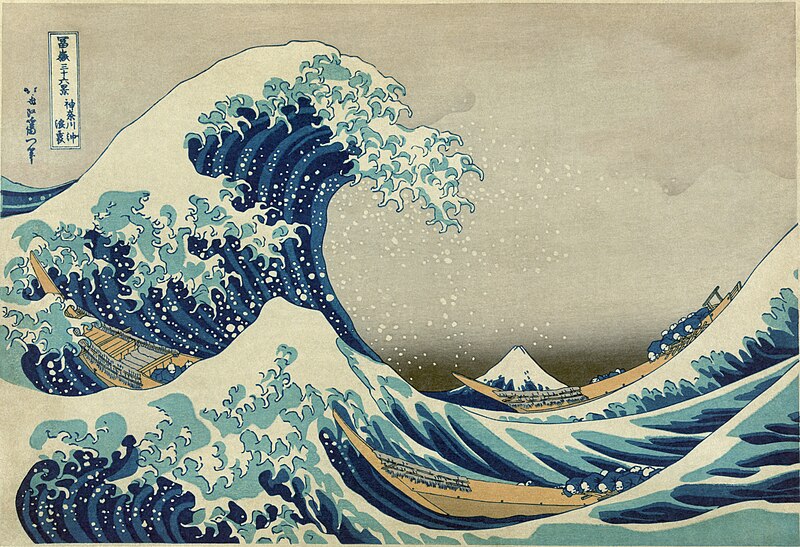
Hokusai (1760–1849) was from Edo and, although he's probably best known for his 36 Views of Mount Fuji (of which in fact there are 46, plus another set of 100), his Great Wave of Kanagawa has in the Occident become iconic and emblematic of woodblock as an art form:

Hokusai (1760–1849) was from Edo and, although he's probably best known for his 36 Views of Mount Fuji (of which in fact there are 46, plus another set of 100), his Great Wave of Kanagawa has in the Occident become iconic and emblematic of woodblock as an art form:
Saturday, January 21, 2012
Winter tanka! (pt 1)
Snow today in Philadelphia—perfect timing to get back to trying to choose 短歌 to write for winter. Fun, because among the possibilities there are always new thoughts, new kanji, new grammatical structures, new images, etc. I'm working with some pages of tanka that 先生 was kind enough to give us. じゃ、習字の日本語が読めない友達も詞を選べるために訳してみましょう!
(I take no responsibility for my attempts at translation below; some of the kanji, grammar, and kanji usage are pre-modern, so it's difficult, and even if they weren't I'd make no guarantees. I try to make the metrics work—57577—but it's not always obvious. でも、頑張りましょうね。)
I'll keep working with them and update these if I can find any more insights. 難しいなぁ。。。。
(Also, the new Blogger interface is weird about line breaks, so, apologies if they're wrong.)
*****
冬ごもの畑(はたけ)に、病の床のガラス戸の曇りぬぐへば足袋干せる見ゆ
正岡子規 MASAOKA shiki (1867–1902)
fuyu gomoru yamai no toko no garasu to no kumori nugueba tabi hoseru miyu
winter confinement—wiping the clouds (or mist, or frost)
from the sickbed's glass door—seeing tabi hung out to dry
*****
木の芽さく、うしろの畑に、霜見えて、けさは身にしむ、山鳩のこゑ
与謝野鉄幹 YOSANO tekkan (1873–1935)
ki no me saku, ushiro no hatake ni, shimo miete, kesa wa mi ni shimu, yamabato no koe
(Check out the amazing monument to him at Bicchuu Matsuyama Castle.)
looking at the frost on the tree's buds in the back field,
wrapped up, this morning; voice of a turtledove
(I'm making a guess at けさはみにしむ; けさ could probably also be "this morning", but a song lyric comes to me: 「闇を抱きしめる」, with "shimeru" as a kind of "wrapping oneself in", which kinda works with the cloak けさ/かさや. There also may be an image of frost blooming さく, but I can't identify the kanji after 木の. Something with 草冠, suggesting a plant connection. Addendum: Updated per tibonchina's help. Beyond my misunderstandings, I'd completely missed a phrase! Still not sure about 身にしむ.)
*****
みづうみの氷は解けてなほ寒し三日月の影波にうつろふ
島赤彦 SHIMAKI akahiko (1876–1926)
ノート: 諏訪湖畔 (by Lake Suwa, Nagano)
mizuumi no
koori ha tokete
naho samushi
mikazuki no kage
nami ni utsurou
the ice on the lake is breaking up, but the chill continues;
the crescent moon's light changes on the waves
(I'm being inconsistent with the transcriptions, I know. I'm taking なほ as なう, probably erroneously, but it seems to work in this context.)
*****
雪降れば山よりくだる小鳥おほし障子の外にひねもす聞ゆ
島木赤彦 SHIMAKI akahiko (1876–1926)
yuki fureba
yama yori kudaru
kotori o hoshi
shouji no soto(?) ni
hinemosu kiyu
as the snow falls, all day i hear, outside the shouji screens,
many little birds, come down from the mountain
(I don't understand the image of dried shouji, but otherwise why ほし? Reminds me of a 茶の湯 friend's story that when she was a kid, whenever her mother was about to replace the shouji screens, she and her sister got to punch through all the paper. Also, I keep thinking that the image should be the voice of the bird coming down from the mountain, but I can't justify that from the poem. Addendum: ほし=多い. I'll have to revisit the meter when I know more [ie, anything] about classical forms.)
*****
眸にしみる暮れしばかりの冬空のあいいろにして月繊くなり
金子薫園 KANEKO kun'en (1896-1951)
me ni shimiru kureshi bakari no fuyuzora no aiiro ni shite tsuki hosoku ari
the sky is turning a winter-sky-just-past-sunset indigo that penetrates the eye; thin moon
I have a bunch more typed out but still need to figure them out to the minimal level.
Miscellany:
- "hoshi" (star) is police slang for a suspect
- the kanji for "shouji" (paper screens) are "hinder" and "child" (障子—or, "hurt" and "child"! 当て字かも知れません。)
(I take no responsibility for my attempts at translation below; some of the kanji, grammar, and kanji usage are pre-modern, so it's difficult, and even if they weren't I'd make no guarantees. I try to make the metrics work—57577—but it's not always obvious. でも、頑張りましょうね。)
I'll keep working with them and update these if I can find any more insights. 難しいなぁ。。。。
(Also, the new Blogger interface is weird about line breaks, so, apologies if they're wrong.)
*****
冬ごもの畑(はたけ)に、病の床のガラス戸の曇りぬぐへば足袋干せる見ゆ
正岡子規 MASAOKA shiki (1867–1902)
fuyu gomoru yamai no toko no garasu to no kumori nugueba tabi hoseru miyu
winter confinement—wiping the clouds (or mist, or frost)
from the sickbed's glass door—seeing tabi hung out to dry
*****
木の芽さく、うしろの畑に、霜見えて、けさは身にしむ、山鳩のこゑ
与謝野鉄幹 YOSANO tekkan (1873–1935)
ki no me saku, ushiro no hatake ni, shimo miete, kesa wa mi ni shimu, yamabato no koe
(Check out the amazing monument to him at Bicchuu Matsuyama Castle.)
looking at the frost on the tree's buds in the back field,
wrapped up, this morning; voice of a turtledove
(I'm making a guess at けさはみにしむ; けさ could probably also be "this morning", but a song lyric comes to me: 「闇を抱きしめる」, with "shimeru" as a kind of "wrapping oneself in", which kinda works with the cloak けさ/かさや. There also may be an image of frost blooming さく, but I can't identify the kanji after 木の. Something with 草冠, suggesting a plant connection. Addendum: Updated per tibonchina's help. Beyond my misunderstandings, I'd completely missed a phrase! Still not sure about 身にしむ.)
*****
みづうみの氷は解けてなほ寒し三日月の影波にうつろふ
島赤彦 SHIMAKI akahiko (1876–1926)
ノート: 諏訪湖畔 (by Lake Suwa, Nagano)
mizuumi no
koori ha tokete
naho samushi
mikazuki no kage
nami ni utsurou
the ice on the lake is breaking up, but the chill continues;
the crescent moon's light changes on the waves
(I'm being inconsistent with the transcriptions, I know. I'm taking なほ as なう, probably erroneously, but it seems to work in this context.)
*****
雪降れば山よりくだる小鳥おほし障子の外にひねもす聞ゆ
島木赤彦 SHIMAKI akahiko (1876–1926)
yuki fureba
yama yori kudaru
kotori o hoshi
shouji no soto(?) ni
hinemosu kiyu
as the snow falls, all day i hear, outside the shouji screens,
many little birds, come down from the mountain
(I don't understand the image of dried shouji, but otherwise why ほし? Reminds me of a 茶の湯 friend's story that when she was a kid, whenever her mother was about to replace the shouji screens, she and her sister got to punch through all the paper. Also, I keep thinking that the image should be the voice of the bird coming down from the mountain, but I can't justify that from the poem. Addendum: ほし=多い. I'll have to revisit the meter when I know more [ie, anything] about classical forms.)
*****
眸にしみる暮れしばかりの冬空のあいいろにして月繊くなり
金子薫園 KANEKO kun'en (1896-1951)
me ni shimiru kureshi bakari no fuyuzora no aiiro ni shite tsuki hosoku ari
the sky is turning a winter-sky-just-past-sunset indigo that penetrates the eye; thin moon
I have a bunch more typed out but still need to figure them out to the minimal level.
Miscellany:
- "hoshi" (star) is police slang for a suspect
- the kanji for "shouji" (paper screens) are "hinder" and "child" (障子—or, "hurt" and "child"! 当て字かも知れません。)
Wednesday, January 18, 2012
You scoop tea *how*?!
Another article I was reading, from Japan Quarterly, recounted a visit to the Midorikai tea intensive (for non–Japanese people) in Kyouto. It's a fun read that also gives an overview of tea, the Sen family, and the Urasenke school and includes interviews with some of the students. One student offered the following remarkable anecdote "that illustrates how chanoyu gives one confidence":
Once a tea master accompanied a feudal lord into town, wearing a sword to appear incognito. There he was challenged to a duel by a samurai. Desperate, he asked a Buddhist priest what he should do. The priest said, "Just handle your sword like a tea scoop." The tea master appeared at the dueling site at the appointed time. He pulled out his sword before the watching samurai and handled it just as he would a tea scoop, upon which the samurai skedaddled.Now, I don't have a ton of experience with tea, and of course I don't suppose the priest meant it literally; but I can't imagine a situation in which handling a katana as one would a chashaku (tea scoop) would result in success. Sounds like a great way to cut your fingers very badly...and probably spill your matcha.
Another take on chanoyu: Prévert's "Déjeuner du matin".
This morning on the way to work I was thinking about tea ceremony, and a poem popped into my head that I learned many moons ago: Jacques Prévert's "Déjeuner du matin":
What struck me about it this morning is that it shares with chanoyu that focus on granular process—doing exactly one thing at a time, in order (and, in this case, while being watched and narrated in past-tense real time!). Both have a central theme of presence, to some degree through ritual—being totally present in the tearoom with the guests, tranquil in that moment and the simple (though not at all simple) actions of making tea—or, in the poem, being slowly emotionally devastated by this string of deliberate, also simple, everyday acts. Both also involve one actor and one relatively passive "guest" (although, of course, "he" is making coffee for himself).
Interesting that much of the tension in the poem derives from the speaker's apparently understanding, while the coffee is being made, that the last act will be departure; in a way it's the exact opposite of the now-focus of tea. But, then, you can also argue that it matches the wabi element of tea practice, in emphasizing the ephemerality of the moment and the poignancy of human experience—that two people can never meet twice and have the same experience (or be the same person), and that each time is the only time. だから「一期一会」と言って、掛け物に書きますね。 Very similar and very different.
And, of course, tea doesn't usually end in tears. (Usually.)
I wonder whether Prévert had any experience with tea. It doesn't seem likely for his Parisian context, and the Net isn't connecting the two for me, so maybe it's just that Prévert arrived at a similar idea of the inner tensions/dynamics/richness/poignancy of a seemingly mundane experience.
(Maybe when leaving "he" said 失礼いたしました—a humble apology for having been in the tearoom at all—before pawing the door closed. I doubt it, but it's fun to think so.)
Il a mis le caféNotwithstanding its emotional tone, it's a great poem for relatively early students of French to learn because the grammar and vocabulary are so (intentionally) basic.
Dans la tasse
he poured the coffee into the cup
Il a mis le lait
Dans la tasse de café
he poured the milk into the cup of coffee
Il a mis le sucre
Dans le café au lait
he put the sugar into the café au lait (or, the coffee and milk)
Avec la petite cuiller
Il a tourné
with the little spoon, he stirred
Il a bu le café au lait
Et il a reposé la tasse
he drank the coffee and set down the cup
Sans me parler
without speaking to me
Il a allumé
Une cigarette
he lit (or lighted, if you prefer) a cigarette
Il a fait des ronds
Avec la fumée
he made rings with the smoke
Il a mis les cendres
Dans le cendrier
he shook the ashes into the ashtray
Sans me parler
Sans me regarder
without speaking to me
without looking at me
Il s'est levé
he stood up
Il a mis
Son chapeau sur sa tête
he put his hat on his head
Il a mis son manteau de pluie
Parce qu'il pleuvait
he put on his raincoat, because it was raining
Et il est parti
and he left
Sous la pluie
in the rain
Sans une parole
without a word
Sans me regarder
without looking at me
Et moi j'ai pris
Ma tête dans ma main
and, me, i took my head into my hand
Et j'ai pleuré
and i cried
What struck me about it this morning is that it shares with chanoyu that focus on granular process—doing exactly one thing at a time, in order (and, in this case, while being watched and narrated in past-tense real time!). Both have a central theme of presence, to some degree through ritual—being totally present in the tearoom with the guests, tranquil in that moment and the simple (though not at all simple) actions of making tea—or, in the poem, being slowly emotionally devastated by this string of deliberate, also simple, everyday acts. Both also involve one actor and one relatively passive "guest" (although, of course, "he" is making coffee for himself).
Interesting that much of the tension in the poem derives from the speaker's apparently understanding, while the coffee is being made, that the last act will be departure; in a way it's the exact opposite of the now-focus of tea. But, then, you can also argue that it matches the wabi element of tea practice, in emphasizing the ephemerality of the moment and the poignancy of human experience—that two people can never meet twice and have the same experience (or be the same person), and that each time is the only time. だから「一期一会」と言って、掛け物に書きますね。 Very similar and very different.
And, of course, tea doesn't usually end in tears. (Usually.)
I wonder whether Prévert had any experience with tea. It doesn't seem likely for his Parisian context, and the Net isn't connecting the two for me, so maybe it's just that Prévert arrived at a similar idea of the inner tensions/dynamics/richness/poignancy of a seemingly mundane experience.
(Maybe when leaving "he" said 失礼いたしました—a humble apology for having been in the tearoom at all—before pawing the door closed. I doubt it, but it's fun to think so.)
Tuesday, January 17, 2012
More paragons of piety.
Not to overbeat the drum, but.... Was just looking up the 24 Paragons of Filial Piety, and I found a very different translation of the titles, with the names of the paragons:
1. Filial Conduct That Impressed The Gods: Shun The Great
2. Personally Checking His Mother's Prescriptions: The Learned Emperor Of Han
3. His Heart Was Pained When His Mother Bit Her Finger: Zeng Shen
4. Clad In A Threadbare Jacket, He Tolerated His Cruel Stepmother: Min Ziqian
5. Carrying Loads Of Rice On His Back To Feed His Parents: Zi Lu
6. Entering Servitude To Pay For His Father's Funeral: Dong Yong
7. Bringing Deers' Milk To His Ailing Parents: Young Master Tan
8. Taking On Menial Labor To Support His Mother: Jiang Ge
9. Stealing Oranges To Take Home For His Mother: Lu Ji
10. Never Tiring Of Feeding Milk To Her Mother-In-Law: Lady Tang
11. Attracting Mosquitos To Drink His Blood: Wu Meng
12. Lying Down On The Ice To Get Carp For His Stepmother: Wang Xiang
13. Burying His Son To Save His Mother: Guo Ju
14. Wrestling With A Tiger To Save His Father: Yang Xiang
15. Resigning Office To Search For His Mother: Zhu Shouchang
16. Deeply Concerned, He Tasted His Father's Stool: Yu Qianlou
17. Costumes And Pranks To Amuse His Parents: Lao Laizi
18. Picking Mulberries For His Mother: Cai Shun
19. He Fanned The Pillow And Warmed the Sheets: Huang Xiang
20. A Bubbling Spring And Leaping Carp: Jiang Shi
21. Crying By The Grave When Thunder Rolled: Wang Weiyuan
22. Serving Wooden Statues Of His Parents: Ding Lan
23. Tears That Brought Bamboo Shoots From The Frozen Earth: Meng Zong
24. Personally Scrubbing His Mother's Chamber Pot: Huang Tingjian.
Why am I so excited to read this (after work)?
1. Filial Conduct That Impressed The Gods: Shun The Great
2. Personally Checking His Mother's Prescriptions: The Learned Emperor Of Han
3. His Heart Was Pained When His Mother Bit Her Finger: Zeng Shen
4. Clad In A Threadbare Jacket, He Tolerated His Cruel Stepmother: Min Ziqian
5. Carrying Loads Of Rice On His Back To Feed His Parents: Zi Lu
6. Entering Servitude To Pay For His Father's Funeral: Dong Yong
7. Bringing Deers' Milk To His Ailing Parents: Young Master Tan
8. Taking On Menial Labor To Support His Mother: Jiang Ge
9. Stealing Oranges To Take Home For His Mother: Lu Ji
10. Never Tiring Of Feeding Milk To Her Mother-In-Law: Lady Tang
11. Attracting Mosquitos To Drink His Blood: Wu Meng
12. Lying Down On The Ice To Get Carp For His Stepmother: Wang Xiang
13. Burying His Son To Save His Mother: Guo Ju
14. Wrestling With A Tiger To Save His Father: Yang Xiang
15. Resigning Office To Search For His Mother: Zhu Shouchang
16. Deeply Concerned, He Tasted His Father's Stool: Yu Qianlou
17. Costumes And Pranks To Amuse His Parents: Lao Laizi
18. Picking Mulberries For His Mother: Cai Shun
19. He Fanned The Pillow And Warmed the Sheets: Huang Xiang
20. A Bubbling Spring And Leaping Carp: Jiang Shi
21. Crying By The Grave When Thunder Rolled: Wang Weiyuan
22. Serving Wooden Statues Of His Parents: Ding Lan
23. Tears That Brought Bamboo Shoots From The Frozen Earth: Meng Zong
24. Personally Scrubbing His Mother's Chamber Pot: Huang Tingjian.
Why am I so excited to read this (after work)?
Thursday, January 12, 2012
Anderson JL, "Japanese tea ritual: religion in practice".
I haven't been able to get to tea class in months, since the past semester started; either class or something else is always standing between me and the park. But recently I've been missing it, and I've found myself in idle moments looking through the Urasenke book, talking myself through ryakubon, and practicing folds with my "fukusa" (which is, in fact, the silk curtain from a toy magic show I had as a kid—since I foolishly left my fukusa, fan, and papers at class last time—but the proportions are about the same).
I have access to scads of journals online through the university, and today while meandering through some publications on traditional Japanese arts/crafts I found a really good read about tea ceremony. It's an early publication by Jennifer L. Anderson, a PhD anthropologist and long-time Urasenke-style tea practitioner (who, as it happens, now teaches at SJSU, with my friend and former college advisor, who loves it there). The piece is called "Japanese tea ritual: religion in practice", and it explores the ritual/philosophical/religious elements of chanoyu in a way that apparently until that time (1987) really hadn't been done in a structured way, at least in Western anthropology.
Some of the piece is mainly academic (literature review on definitions of ritual), but it's a rewarding read, and I recommend it if you're interested in tea.
I find the spiritual elements of shuuji and tea elusive. My background is Anglo-Catholic but really secular, and although I've done some reading on the concepts, my understanding is only superficial. So, this was a very helpful read for me. Anderson takes us through the whole process of a chaji, pausing now and then to explore the deeper meanings of apparently simple actions:
The high point of the entire ritual takes place as the main guest tastes his initial sip of koicha tea. If host and guest are to experience a deep sense of shared tranquillity, it will be now. Ideally, the guest feels deep gratitude for everything that has gone into creating the wonderful experience epitomised by the first sip of tea. And the host senses that he has successfully communicated something deeply important to someone who understands the meaning of his effort. For one moment, both have the opportunity to experience an unfathomable sense of 'wholeness, health, and holiness'.... Chado exists to make this moment plausible. Symbols which link host and guest to their forebears, to society, to various philosophies, to the phenomenal world, and ultimately, to the cosmos are concentrated in this one cup of tea.There's a lot of other gold in the piece, too, such as the elemental and "virtual" associations of the nine segments of a four-and-a-half-mat tearoom, the communicative intent of the host's actions (such as placing bound stones and sprinkling water on the roji path), and the beautiful "和敬清寂" (wa-kei-sei-jaku, peace/respect/purity/tranquility), "the central litany of tea values". It's an expression I'd never heard before, and googling it pops up all kinds of Japanese 茶道 sites. (If I'm feeling ambitious sometime, maybe I'll try to write it; I've written wa and sei before, but the other two are daunting!)
Some of the piece is mainly academic (literature review on definitions of ritual), but it's a rewarding read, and I recommend it if you're interested in tea.
Anderson JL. Japanese tea ritual: religion in practice. Man: The Journal of the Royal Anthropological Society of Great Britain and Ireland. 1987;22:475-498.If you can't access the article, let me know, and I'll try to e-mail it to you.
the article is online here
Dr Anderson has a page of nifty chanoyu resources, here
Her An Introduction to Japanese Tea Ritual is on Amazon, here
喫茶去!
Tuesday, January 10, 2012
章甫を資して越に適く。(proverb: selling Yin caps in Vietnam?)
One more little bit of interest about fumizome: when I tried to google the word in kana, Google suggested replacing ふみはじめ with 章甫を資して越に適く, a string that I admit I don't understand at all. This Japanese proverb site gives it in kana: しょうほをししてえつにゆく (shouho o shishite, etsu ni yuku)—so, presumably it's a proverb. The site explains thusly:
That ”kan/kanmuri/kanburi" can also be a crown or coronet, as in the kanmuri kanji radicals, and seems also to carry a sense of rank; makes me wonder about the nature of this "cap": if "etsu" really is Vietnam—or whatever "other" nation—was there a sense among the people who originated the proverb that shouho were beautiful/refined/noble things that would be wasted on those other people? Like our "casting pearls before swine"? This image from a Chinese site purports to be shouho; it doesn't look so very impressive, especially when compared to other styles (such a those on this page, which mentions shouho in category 8, which is nothing like the image above, and seems not to include it in any of the images).
It really is amazing to think that if this really is a Yin/Shang-era proverb, the it dates to the second millennium BCE. Maybe I can ask about it on a forum on ancient Chinese headdresses. When I have less work to do.
Or, maybe nothing I've said above is anywhere near the true interpretation of "shouho o shishite, etsu ni yuku". 道理に外れたかもしれませんが、しょうが無いでしょうね。
道理にはずれた行為や見当違いなことをするたとえで、あるところでは必要なものでも、所によっては不必要とされるたとえで。程度の低いものには高尚なことは理解できないことのたとえにもいう。章甫の冠を売ろうとして、冠などかぶらない越の国へ行く意味から。「章甫」殷代の冠の名。ちょっと訳してみましょう:
道理にはずれた行為や見当違いなことをするThis kind of thing makes me despair of ever really understanding Japanese! I still don't understand 資す (taking part in?—maybe "offering") in this context, but I think I kinda-sorta get the sense of it. Like our idea of "selling ice to an Eskimo"—don't even bother!
douri ni hazurete, koui ya kentou-chigai na koto o suru.
to act in a way that's mistaken or untrue / not sensible.
たとえで、あるところでは必要なものでも、
所によっては不必要とされるたとえで。
tatoeba, aru tokoro de ha hitsuyou na mono de mo,
tokoro ni yotte ha fuhitsuyou to sareru tatoe de.
e.g., a thing that's useful in one place may not be thought so in another.
程度の低いものには高尚なことは
理解できないことのたとえにもいう。
teido no hikui mono ni ha koujou na koto ha
rikai dekinai koto no tatoe ni mo iu.
Also said of not understanding the difference between refined and worthless things. (Or, depending on "mono"—because it's followed by "koto"—that people who are low in degree don't understand refined things.)
章甫の冠を売ろうとして、
冠などかぶらない越の国へ行く意味から。
Shouho no kanmuri (kanburi, kan?) o urou to shite,
kan (etc.) nado kaburanai etsu no kuni ni iku (yuku) imi kara.
From the sense of going to Vietnam (the country across), where they don't wear caps and such, to try to sell shouho caps.
「章甫」殷代の冠の名。
"shouho", indai no kanburi no mei (na?).
"Shouho" was a kind of cap/hat in the Yin (Shang) Dynasty.
That ”kan/kanmuri/kanburi" can also be a crown or coronet, as in the kanmuri kanji radicals, and seems also to carry a sense of rank; makes me wonder about the nature of this "cap": if "etsu" really is Vietnam—or whatever "other" nation—was there a sense among the people who originated the proverb that shouho were beautiful/refined/noble things that would be wasted on those other people? Like our "casting pearls before swine"? This image from a Chinese site purports to be shouho; it doesn't look so very impressive, especially when compared to other styles (such a those on this page, which mentions shouho in category 8, which is nothing like the image above, and seems not to include it in any of the images).
It really is amazing to think that if this really is a Yin/Shang-era proverb, the it dates to the second millennium BCE. Maybe I can ask about it on a forum on ancient Chinese headdresses. When I have less work to do.
Or, maybe nothing I've said above is anywhere near the true interpretation of "shouho o shishite, etsu ni yuku". 道理に外れたかもしれませんが、しょうが無いでしょうね。
ふみはじめのしき? (書初めの式) And kakizome?
I have a 源氏物語 (Tale of Genji) app on my phone, so sometimes when I'm walking somewhere I'll open it up and try to read a little. Sometimes I can; sometimes, not so much. But this morning I saw something particularly interesting: 書き初め, with furigana given as ふみはじめ—"the start of writing". (I haven't seen the reading "fumi" before for that kanji, and per Jisho.org it seems no longer extant—unless I misremembered the kanji while getting off the elevator.) This being January, I wondered whether it might have some relation to modern kakizome (書初め、書き初め、書初—written with exactly the same kanji), the first writing of the new year. So what is, or was, fumi-hajime?
This book translates the scene and offers some insight:
This book translates the scene and offers some insight:
The boy lived entirely at court from then on. When he was seven, the emperor held the first reading, and he was so unbelievably quick and bright that his father actually worried about the significance of such brilliance.A footnote explains,"I don't see how anyone could dislike him now," the emperor said....
The first reading (fumihajime) was usually performed when the son of a high-ranking family reached the age of seven or eight. Ostensibly designed to show the child how to read, it was a largely symbolic event, during which the young principal, dressed in elaborate robes, repeated a few words after hearing them read aloud from the Classic of Filial Piety or some other suitable text.The much earlier A Tale of Flowering Fortunes (1980), also by Helen McCullough, translates an account of a historical fumihajime and includes more detail in the footnote:[Helen Craig McCullough, Genji and Heike: Selections from The Tale of Genji and The Tale of the Heike]
...[I]t was a purely symbolic event, during which the elaborately robed young principal sat in silence while a Reader (Jidoku) intoned, and a Repeater (Shoufuku) repeated, a few words from a suitable text, usually the Classic of Filial Piety (Hsiao-ching). At Crown Prince Atsuhira's fumihajime, held on the Twenty-eighth of the Eleventh Month, 1014, in the Tsuchimikado Mansion, only the title and the first four characters of the Hsiao-ching were read. As was usual, the assembled dignitaries then adjourned to another part of the mansion for a banquet. Shouyuuki, 3: 255 (28 xi Chouwa 3). (Shouyuuki is apparently a period court diary—ed.) For a picture of a fumihajime ceremony, see Genji, 1: 493, item 31.So, I guess the young noble dressed up, repeated a few words (not even from memory), and got his trophy, and then everyone ate. Welcome to adulthood, kid. :-)
Interestingly, this 19th-century dictionary (by Hepburn, a very interesting missionary from Pennsylvania who helped romanize Japanese and whose school in Japan became Meiji Gakuin) defines fumihajime as the first writing of the new year and gives "kakisome" as a synonym, and doesn't even mention reading or classical ceremony. So, as in words like 書類, maybe in this case there's some fluidity between writing and reading, and the sense was more of "the first text".
(I also notice "kakisokonau", "to make a mistake in writing"—a good word to know, especially as the second kanji is not any variant of "to make a mistake", but rather 損なう, to harm, hurt, injure, damage, or fail. Like the first time I tried to write shikishi—書き損なっちゃったなぁ。。。)
Just for fun: apparently there's another classic of filial piety that could be read from at fumihajime, called 24 Paragons of Filial Piety. These are the paragons:
The Feeling of Filial Piety Moved HeavenSounds like a super fun read. 楽しそうだと思いますよね。
Her Son Tasted Soups and Medicine
Zengzi's mother: She Bit Her Finger and Pained His Heart
He Obeyed His Mother in Simple Clothes
He Shouldered Rice To Nourish His Parents
He Sold Himself To Bury His Father
He Fed His Parents Doe's Milk
He Hired Out To Support His Mother
He Concealed Oranges To Present To His Mother
She Suckled Her Mother-In-Law
He Let Mosquitoes Consume His Blood
Wang Xiang Lay on Ice in Search of Carp
He Buried His Son for His Mother
He Strangled A Tiger To Save His Father
He Abandoned His Post To Seek His Mother
He Tasted Dung With an Anxious Heart
He Amused His Parents With Play and Glad Clothes
He Picked Mulberries To Serve His Mother
He Fanned the Pillow and Warmed the Quilt
The Fountain Bubbled and the Carps Leapt Out
He Heard Thunder and Wept at the Grave
He Carved Wood To Serve His Parents
He Wept Till the Bamboo Sprouted
He Washed His Mother's Bedpan
Subscribe to:
Posts (Atom)
