Saturday, February 4, 2012
Winter tanka! (pt 2)
冬山に 来つつ しづけき心なり。 われひとり 出でて 踏む 道の霜
釈迢空 ORIKUCHI shinobu, a.k.a. shaku-chou-kuu (1887–1953)
fuyuyama ni kitatsutsu
shizukeki kokoro nari.
ware hitori idete
fumu
michi no shimo
arriving at the wintry mountain brings peace to my heart; I've come alone, and I step—into the road's frost
(The spacing isn't usual but reflects the formatting on the page, which must be mirroring how someone wrote it at some point. In fact, the last line is on the next page.)
松毬もおつるかぎり落ちはててこの冬の日に音一つなき
吉植庄亮 YOSHIUE shouryou (1884–1958)
matsukasa mo
otsuru kagiri (ni?)
ochihatete
kono fuyu no hi ni
oto hitotsu naki
the pinecone, too, reaches its time and drops from the tree; on this winter day, sound of a single cry
The award for weird kanji of the day goes to 毬. I don't think I'd ever seen けへん (?) before. I'm guessing おつる is related to おちる/おとす, to fall (or drop). The second line is all in kana, but the meter seems off; is it possible there should be a に ("限りに", at the limit)? はてる is interesting; there's a real sense of "at the absolute end". (Cf. Miyuki Nakajima: "涙もかれ果てて", having completely run out of tears. I've nosed around for more examples of "ochihateru", but aside from an adult comic I'm not finding much.)
夕寒く土間の鷄らのかえりつつ竈の榾火は燃えとろみ居り
吉植庄亮 YOSHIUE shouryou (1884–1958)
yoru samuku
doma no torira no
kaeritsutsu
kudo no hodabi wa
moetoromi ori/iri
in the night's cold—as the chickens come home to the dirt-floored house—the kindling burns down in the hearth
I'm guessing ら is pluralizing 鶏. "Doma" is a little strange, but per image search it seems to mean not just the floor, but a dirt-floored building, so maybe we're talking about chickens that belong to that house—土間の鶏の帰り. Or maybe not! Not sure what to do with 燃えとろみ; it seems to be nominal and be about burning (燃える), but the second half—a combination with とる, maybe?
炬燵して寒きをいとへ窓の下の蓮田の枯葉けふもしぐるる
中村憲吉 NAKAMURA kenkichi (1889–1934)
kotatsu shite
samuki o itoe
mado no (shita?) no
hasuda(?) no kareha
kyou mo shigururu
staving off the cold with the brazier; withered leaves in the hibiscus (or lotus) patch under (outside) the window. today, again, winter rain
(I'm taking いとえ as a form of 厭う/厭える, which may be off the wall but makes sense with炬燵 and 寒き. Not sure about まどのしたの because it's off meter. I'm just guessing at はすだ, but I feel OK about it because there's a city by that name in Saitama—so, at least the word exists with those kanji. して here seems to have the sense of で/を使って, rather than する, per Shirane §12.9.)


2011 earthquake data, condensed.
I can't embed it because Google is having an identity crisis, so here it is.
Assuming this is based on valid data, etc., I concur with a YouTube commentator: Dam nature, you scary.
Friday, February 3, 2012
Hokusai prints lost at sea?!
Seems there was, aboard the recently-capsized Costa Concordia, a collection of woodblock prints by KATSUSHIKA Hokusai (葛飾北斎). 残念ですね!Apparently they were in a spa that seems to have been on the Spagna deck, third deck down, fore, probably on the port side; not sure whether that part of the ship is actually underwater, but since the ship is submerged on the starboard side, maybe there's hope.
Hokusai (1760–1849) was from Edo and, although he's probably best known for his 36 Views of Mount Fuji (of which in fact there are 46, plus another set of 100), his Great Wave of Kanagawa has in the Occident become iconic and emblematic of woodblock as an art form:
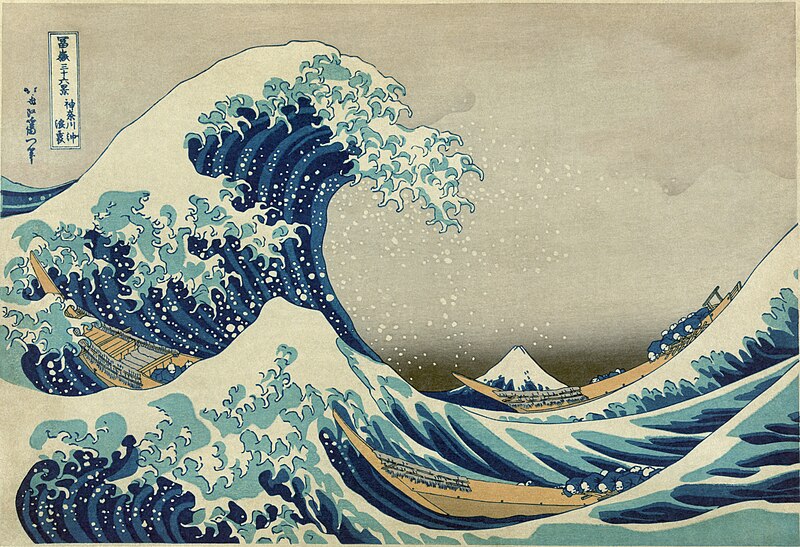
Hokusai (1760–1849) was from Edo and, although he's probably best known for his 36 Views of Mount Fuji (of which in fact there are 46, plus another set of 100), his Great Wave of Kanagawa has in the Occident become iconic and emblematic of woodblock as an art form:
Saturday, January 21, 2012
Winter tanka! (pt 1)
Snow today in Philadelphia—perfect timing to get back to trying to choose 短歌 to write for winter. Fun, because among the possibilities there are always new thoughts, new kanji, new grammatical structures, new images, etc. I'm working with some pages of tanka that 先生 was kind enough to give us. じゃ、習字の日本語が読めない友達も詞を選べるために訳してみましょう!
(I take no responsibility for my attempts at translation below; some of the kanji, grammar, and kanji usage are pre-modern, so it's difficult, and even if they weren't I'd make no guarantees. I try to make the metrics work—57577—but it's not always obvious. でも、頑張りましょうね。)
I'll keep working with them and update these if I can find any more insights. 難しいなぁ。。。。
(Also, the new Blogger interface is weird about line breaks, so, apologies if they're wrong.)
*****
冬ごもの畑(はたけ)に、病の床のガラス戸の曇りぬぐへば足袋干せる見ゆ
正岡子規 MASAOKA shiki (1867–1902)
fuyu gomoru yamai no toko no garasu to no kumori nugueba tabi hoseru miyu
winter confinement—wiping the clouds (or mist, or frost)
from the sickbed's glass door—seeing tabi hung out to dry
*****
木の芽さく、うしろの畑に、霜見えて、けさは身にしむ、山鳩のこゑ
与謝野鉄幹 YOSANO tekkan (1873–1935)
ki no me saku, ushiro no hatake ni, shimo miete, kesa wa mi ni shimu, yamabato no koe
(Check out the amazing monument to him at Bicchuu Matsuyama Castle.)
looking at the frost on the tree's buds in the back field,
wrapped up, this morning; voice of a turtledove
(I'm making a guess at けさはみにしむ; けさ could probably also be "this morning", but a song lyric comes to me: 「闇を抱きしめる」, with "shimeru" as a kind of "wrapping oneself in", which kinda works with the cloak けさ/かさや. There also may be an image of frost blooming さく, but I can't identify the kanji after 木の. Something with 草冠, suggesting a plant connection. Addendum: Updated per tibonchina's help. Beyond my misunderstandings, I'd completely missed a phrase! Still not sure about 身にしむ.)
*****
みづうみの氷は解けてなほ寒し三日月の影波にうつろふ
島赤彦 SHIMAKI akahiko (1876–1926)
ノート: 諏訪湖畔 (by Lake Suwa, Nagano)
mizuumi no
koori ha tokete
naho samushi
mikazuki no kage
nami ni utsurou
the ice on the lake is breaking up, but the chill continues;
the crescent moon's light changes on the waves
(I'm being inconsistent with the transcriptions, I know. I'm taking なほ as なう, probably erroneously, but it seems to work in this context.)
*****
雪降れば山よりくだる小鳥おほし障子の外にひねもす聞ゆ
島木赤彦 SHIMAKI akahiko (1876–1926)
yuki fureba
yama yori kudaru
kotori o hoshi
shouji no soto(?) ni
hinemosu kiyu
as the snow falls, all day i hear, outside the shouji screens,
many little birds, come down from the mountain
(I don't understand the image of dried shouji, but otherwise why ほし? Reminds me of a 茶の湯 friend's story that when she was a kid, whenever her mother was about to replace the shouji screens, she and her sister got to punch through all the paper. Also, I keep thinking that the image should be the voice of the bird coming down from the mountain, but I can't justify that from the poem. Addendum: ほし=多い. I'll have to revisit the meter when I know more [ie, anything] about classical forms.)
*****
眸にしみる暮れしばかりの冬空のあいいろにして月繊くなり
金子薫園 KANEKO kun'en (1896-1951)
me ni shimiru kureshi bakari no fuyuzora no aiiro ni shite tsuki hosoku ari
the sky is turning a winter-sky-just-past-sunset indigo that penetrates the eye; thin moon
I have a bunch more typed out but still need to figure them out to the minimal level.
Miscellany:
- "hoshi" (star) is police slang for a suspect
- the kanji for "shouji" (paper screens) are "hinder" and "child" (障子—or, "hurt" and "child"! 当て字かも知れません。)
(I take no responsibility for my attempts at translation below; some of the kanji, grammar, and kanji usage are pre-modern, so it's difficult, and even if they weren't I'd make no guarantees. I try to make the metrics work—57577—but it's not always obvious. でも、頑張りましょうね。)
I'll keep working with them and update these if I can find any more insights. 難しいなぁ。。。。
(Also, the new Blogger interface is weird about line breaks, so, apologies if they're wrong.)
*****
冬ごもの畑(はたけ)に、病の床のガラス戸の曇りぬぐへば足袋干せる見ゆ
正岡子規 MASAOKA shiki (1867–1902)
fuyu gomoru yamai no toko no garasu to no kumori nugueba tabi hoseru miyu
winter confinement—wiping the clouds (or mist, or frost)
from the sickbed's glass door—seeing tabi hung out to dry
*****
木の芽さく、うしろの畑に、霜見えて、けさは身にしむ、山鳩のこゑ
与謝野鉄幹 YOSANO tekkan (1873–1935)
ki no me saku, ushiro no hatake ni, shimo miete, kesa wa mi ni shimu, yamabato no koe
(Check out the amazing monument to him at Bicchuu Matsuyama Castle.)
looking at the frost on the tree's buds in the back field,
wrapped up, this morning; voice of a turtledove
(I'm making a guess at けさはみにしむ; けさ could probably also be "this morning", but a song lyric comes to me: 「闇を抱きしめる」, with "shimeru" as a kind of "wrapping oneself in", which kinda works with the cloak けさ/かさや. There also may be an image of frost blooming さく, but I can't identify the kanji after 木の. Something with 草冠, suggesting a plant connection. Addendum: Updated per tibonchina's help. Beyond my misunderstandings, I'd completely missed a phrase! Still not sure about 身にしむ.)
*****
みづうみの氷は解けてなほ寒し三日月の影波にうつろふ
島赤彦 SHIMAKI akahiko (1876–1926)
ノート: 諏訪湖畔 (by Lake Suwa, Nagano)
mizuumi no
koori ha tokete
naho samushi
mikazuki no kage
nami ni utsurou
the ice on the lake is breaking up, but the chill continues;
the crescent moon's light changes on the waves
(I'm being inconsistent with the transcriptions, I know. I'm taking なほ as なう, probably erroneously, but it seems to work in this context.)
*****
雪降れば山よりくだる小鳥おほし障子の外にひねもす聞ゆ
島木赤彦 SHIMAKI akahiko (1876–1926)
yuki fureba
yama yori kudaru
kotori o hoshi
shouji no soto(?) ni
hinemosu kiyu
as the snow falls, all day i hear, outside the shouji screens,
many little birds, come down from the mountain
(I don't understand the image of dried shouji, but otherwise why ほし? Reminds me of a 茶の湯 friend's story that when she was a kid, whenever her mother was about to replace the shouji screens, she and her sister got to punch through all the paper. Also, I keep thinking that the image should be the voice of the bird coming down from the mountain, but I can't justify that from the poem. Addendum: ほし=多い. I'll have to revisit the meter when I know more [ie, anything] about classical forms.)
*****
眸にしみる暮れしばかりの冬空のあいいろにして月繊くなり
金子薫園 KANEKO kun'en (1896-1951)
me ni shimiru kureshi bakari no fuyuzora no aiiro ni shite tsuki hosoku ari
the sky is turning a winter-sky-just-past-sunset indigo that penetrates the eye; thin moon
I have a bunch more typed out but still need to figure them out to the minimal level.
Miscellany:
- "hoshi" (star) is police slang for a suspect
- the kanji for "shouji" (paper screens) are "hinder" and "child" (障子—or, "hurt" and "child"! 当て字かも知れません。)
Wednesday, January 18, 2012
You scoop tea *how*?!
Another article I was reading, from Japan Quarterly, recounted a visit to the Midorikai tea intensive (for non–Japanese people) in Kyouto. It's a fun read that also gives an overview of tea, the Sen family, and the Urasenke school and includes interviews with some of the students. One student offered the following remarkable anecdote "that illustrates how chanoyu gives one confidence":
Once a tea master accompanied a feudal lord into town, wearing a sword to appear incognito. There he was challenged to a duel by a samurai. Desperate, he asked a Buddhist priest what he should do. The priest said, "Just handle your sword like a tea scoop." The tea master appeared at the dueling site at the appointed time. He pulled out his sword before the watching samurai and handled it just as he would a tea scoop, upon which the samurai skedaddled.Now, I don't have a ton of experience with tea, and of course I don't suppose the priest meant it literally; but I can't imagine a situation in which handling a katana as one would a chashaku (tea scoop) would result in success. Sounds like a great way to cut your fingers very badly...and probably spill your matcha.
Another take on chanoyu: Prévert's "Déjeuner du matin".
This morning on the way to work I was thinking about tea ceremony, and a poem popped into my head that I learned many moons ago: Jacques Prévert's "Déjeuner du matin":
What struck me about it this morning is that it shares with chanoyu that focus on granular process—doing exactly one thing at a time, in order (and, in this case, while being watched and narrated in past-tense real time!). Both have a central theme of presence, to some degree through ritual—being totally present in the tearoom with the guests, tranquil in that moment and the simple (though not at all simple) actions of making tea—or, in the poem, being slowly emotionally devastated by this string of deliberate, also simple, everyday acts. Both also involve one actor and one relatively passive "guest" (although, of course, "he" is making coffee for himself).
Interesting that much of the tension in the poem derives from the speaker's apparently understanding, while the coffee is being made, that the last act will be departure; in a way it's the exact opposite of the now-focus of tea. But, then, you can also argue that it matches the wabi element of tea practice, in emphasizing the ephemerality of the moment and the poignancy of human experience—that two people can never meet twice and have the same experience (or be the same person), and that each time is the only time. だから「一期一会」と言って、掛け物に書きますね。 Very similar and very different.
And, of course, tea doesn't usually end in tears. (Usually.)
I wonder whether Prévert had any experience with tea. It doesn't seem likely for his Parisian context, and the Net isn't connecting the two for me, so maybe it's just that Prévert arrived at a similar idea of the inner tensions/dynamics/richness/poignancy of a seemingly mundane experience.
(Maybe when leaving "he" said 失礼いたしました—a humble apology for having been in the tearoom at all—before pawing the door closed. I doubt it, but it's fun to think so.)
Il a mis le caféNotwithstanding its emotional tone, it's a great poem for relatively early students of French to learn because the grammar and vocabulary are so (intentionally) basic.
Dans la tasse
he poured the coffee into the cup
Il a mis le lait
Dans la tasse de café
he poured the milk into the cup of coffee
Il a mis le sucre
Dans le café au lait
he put the sugar into the café au lait (or, the coffee and milk)
Avec la petite cuiller
Il a tourné
with the little spoon, he stirred
Il a bu le café au lait
Et il a reposé la tasse
he drank the coffee and set down the cup
Sans me parler
without speaking to me
Il a allumé
Une cigarette
he lit (or lighted, if you prefer) a cigarette
Il a fait des ronds
Avec la fumée
he made rings with the smoke
Il a mis les cendres
Dans le cendrier
he shook the ashes into the ashtray
Sans me parler
Sans me regarder
without speaking to me
without looking at me
Il s'est levé
he stood up
Il a mis
Son chapeau sur sa tête
he put his hat on his head
Il a mis son manteau de pluie
Parce qu'il pleuvait
he put on his raincoat, because it was raining
Et il est parti
and he left
Sous la pluie
in the rain
Sans une parole
without a word
Sans me regarder
without looking at me
Et moi j'ai pris
Ma tête dans ma main
and, me, i took my head into my hand
Et j'ai pleuré
and i cried
What struck me about it this morning is that it shares with chanoyu that focus on granular process—doing exactly one thing at a time, in order (and, in this case, while being watched and narrated in past-tense real time!). Both have a central theme of presence, to some degree through ritual—being totally present in the tearoom with the guests, tranquil in that moment and the simple (though not at all simple) actions of making tea—or, in the poem, being slowly emotionally devastated by this string of deliberate, also simple, everyday acts. Both also involve one actor and one relatively passive "guest" (although, of course, "he" is making coffee for himself).
Interesting that much of the tension in the poem derives from the speaker's apparently understanding, while the coffee is being made, that the last act will be departure; in a way it's the exact opposite of the now-focus of tea. But, then, you can also argue that it matches the wabi element of tea practice, in emphasizing the ephemerality of the moment and the poignancy of human experience—that two people can never meet twice and have the same experience (or be the same person), and that each time is the only time. だから「一期一会」と言って、掛け物に書きますね。 Very similar and very different.
And, of course, tea doesn't usually end in tears. (Usually.)
I wonder whether Prévert had any experience with tea. It doesn't seem likely for his Parisian context, and the Net isn't connecting the two for me, so maybe it's just that Prévert arrived at a similar idea of the inner tensions/dynamics/richness/poignancy of a seemingly mundane experience.
(Maybe when leaving "he" said 失礼いたしました—a humble apology for having been in the tearoom at all—before pawing the door closed. I doubt it, but it's fun to think so.)
Tuesday, January 17, 2012
More paragons of piety.
Not to overbeat the drum, but.... Was just looking up the 24 Paragons of Filial Piety, and I found a very different translation of the titles, with the names of the paragons:
1. Filial Conduct That Impressed The Gods: Shun The Great
2. Personally Checking His Mother's Prescriptions: The Learned Emperor Of Han
3. His Heart Was Pained When His Mother Bit Her Finger: Zeng Shen
4. Clad In A Threadbare Jacket, He Tolerated His Cruel Stepmother: Min Ziqian
5. Carrying Loads Of Rice On His Back To Feed His Parents: Zi Lu
6. Entering Servitude To Pay For His Father's Funeral: Dong Yong
7. Bringing Deers' Milk To His Ailing Parents: Young Master Tan
8. Taking On Menial Labor To Support His Mother: Jiang Ge
9. Stealing Oranges To Take Home For His Mother: Lu Ji
10. Never Tiring Of Feeding Milk To Her Mother-In-Law: Lady Tang
11. Attracting Mosquitos To Drink His Blood: Wu Meng
12. Lying Down On The Ice To Get Carp For His Stepmother: Wang Xiang
13. Burying His Son To Save His Mother: Guo Ju
14. Wrestling With A Tiger To Save His Father: Yang Xiang
15. Resigning Office To Search For His Mother: Zhu Shouchang
16. Deeply Concerned, He Tasted His Father's Stool: Yu Qianlou
17. Costumes And Pranks To Amuse His Parents: Lao Laizi
18. Picking Mulberries For His Mother: Cai Shun
19. He Fanned The Pillow And Warmed the Sheets: Huang Xiang
20. A Bubbling Spring And Leaping Carp: Jiang Shi
21. Crying By The Grave When Thunder Rolled: Wang Weiyuan
22. Serving Wooden Statues Of His Parents: Ding Lan
23. Tears That Brought Bamboo Shoots From The Frozen Earth: Meng Zong
24. Personally Scrubbing His Mother's Chamber Pot: Huang Tingjian.
Why am I so excited to read this (after work)?
1. Filial Conduct That Impressed The Gods: Shun The Great
2. Personally Checking His Mother's Prescriptions: The Learned Emperor Of Han
3. His Heart Was Pained When His Mother Bit Her Finger: Zeng Shen
4. Clad In A Threadbare Jacket, He Tolerated His Cruel Stepmother: Min Ziqian
5. Carrying Loads Of Rice On His Back To Feed His Parents: Zi Lu
6. Entering Servitude To Pay For His Father's Funeral: Dong Yong
7. Bringing Deers' Milk To His Ailing Parents: Young Master Tan
8. Taking On Menial Labor To Support His Mother: Jiang Ge
9. Stealing Oranges To Take Home For His Mother: Lu Ji
10. Never Tiring Of Feeding Milk To Her Mother-In-Law: Lady Tang
11. Attracting Mosquitos To Drink His Blood: Wu Meng
12. Lying Down On The Ice To Get Carp For His Stepmother: Wang Xiang
13. Burying His Son To Save His Mother: Guo Ju
14. Wrestling With A Tiger To Save His Father: Yang Xiang
15. Resigning Office To Search For His Mother: Zhu Shouchang
16. Deeply Concerned, He Tasted His Father's Stool: Yu Qianlou
17. Costumes And Pranks To Amuse His Parents: Lao Laizi
18. Picking Mulberries For His Mother: Cai Shun
19. He Fanned The Pillow And Warmed the Sheets: Huang Xiang
20. A Bubbling Spring And Leaping Carp: Jiang Shi
21. Crying By The Grave When Thunder Rolled: Wang Weiyuan
22. Serving Wooden Statues Of His Parents: Ding Lan
23. Tears That Brought Bamboo Shoots From The Frozen Earth: Meng Zong
24. Personally Scrubbing His Mother's Chamber Pot: Huang Tingjian.
Why am I so excited to read this (after work)?
Thursday, January 12, 2012
Anderson JL, "Japanese tea ritual: religion in practice".
I haven't been able to get to tea class in months, since the past semester started; either class or something else is always standing between me and the park. But recently I've been missing it, and I've found myself in idle moments looking through the Urasenke book, talking myself through ryakubon, and practicing folds with my "fukusa" (which is, in fact, the silk curtain from a toy magic show I had as a kid—since I foolishly left my fukusa, fan, and papers at class last time—but the proportions are about the same).
I have access to scads of journals online through the university, and today while meandering through some publications on traditional Japanese arts/crafts I found a really good read about tea ceremony. It's an early publication by Jennifer L. Anderson, a PhD anthropologist and long-time Urasenke-style tea practitioner (who, as it happens, now teaches at SJSU, with my friend and former college advisor, who loves it there). The piece is called "Japanese tea ritual: religion in practice", and it explores the ritual/philosophical/religious elements of chanoyu in a way that apparently until that time (1987) really hadn't been done in a structured way, at least in Western anthropology.
Some of the piece is mainly academic (literature review on definitions of ritual), but it's a rewarding read, and I recommend it if you're interested in tea.
I find the spiritual elements of shuuji and tea elusive. My background is Anglo-Catholic but really secular, and although I've done some reading on the concepts, my understanding is only superficial. So, this was a very helpful read for me. Anderson takes us through the whole process of a chaji, pausing now and then to explore the deeper meanings of apparently simple actions:
The high point of the entire ritual takes place as the main guest tastes his initial sip of koicha tea. If host and guest are to experience a deep sense of shared tranquillity, it will be now. Ideally, the guest feels deep gratitude for everything that has gone into creating the wonderful experience epitomised by the first sip of tea. And the host senses that he has successfully communicated something deeply important to someone who understands the meaning of his effort. For one moment, both have the opportunity to experience an unfathomable sense of 'wholeness, health, and holiness'.... Chado exists to make this moment plausible. Symbols which link host and guest to their forebears, to society, to various philosophies, to the phenomenal world, and ultimately, to the cosmos are concentrated in this one cup of tea.There's a lot of other gold in the piece, too, such as the elemental and "virtual" associations of the nine segments of a four-and-a-half-mat tearoom, the communicative intent of the host's actions (such as placing bound stones and sprinkling water on the roji path), and the beautiful "和敬清寂" (wa-kei-sei-jaku, peace/respect/purity/tranquility), "the central litany of tea values". It's an expression I'd never heard before, and googling it pops up all kinds of Japanese 茶道 sites. (If I'm feeling ambitious sometime, maybe I'll try to write it; I've written wa and sei before, but the other two are daunting!)
Some of the piece is mainly academic (literature review on definitions of ritual), but it's a rewarding read, and I recommend it if you're interested in tea.
Anderson JL. Japanese tea ritual: religion in practice. Man: The Journal of the Royal Anthropological Society of Great Britain and Ireland. 1987;22:475-498.If you can't access the article, let me know, and I'll try to e-mail it to you.
the article is online here
Dr Anderson has a page of nifty chanoyu resources, here
Her An Introduction to Japanese Tea Ritual is on Amazon, here
喫茶去!
Tuesday, January 10, 2012
章甫を資して越に適く。(proverb: selling Yin caps in Vietnam?)
One more little bit of interest about fumizome: when I tried to google the word in kana, Google suggested replacing ふみはじめ with 章甫を資して越に適く, a string that I admit I don't understand at all. This Japanese proverb site gives it in kana: しょうほをししてえつにゆく (shouho o shishite, etsu ni yuku)—so, presumably it's a proverb. The site explains thusly:
That ”kan/kanmuri/kanburi" can also be a crown or coronet, as in the kanmuri kanji radicals, and seems also to carry a sense of rank; makes me wonder about the nature of this "cap": if "etsu" really is Vietnam—or whatever "other" nation—was there a sense among the people who originated the proverb that shouho were beautiful/refined/noble things that would be wasted on those other people? Like our "casting pearls before swine"? This image from a Chinese site purports to be shouho; it doesn't look so very impressive, especially when compared to other styles (such a those on this page, which mentions shouho in category 8, which is nothing like the image above, and seems not to include it in any of the images).
It really is amazing to think that if this really is a Yin/Shang-era proverb, the it dates to the second millennium BCE. Maybe I can ask about it on a forum on ancient Chinese headdresses. When I have less work to do.
Or, maybe nothing I've said above is anywhere near the true interpretation of "shouho o shishite, etsu ni yuku". 道理に外れたかもしれませんが、しょうが無いでしょうね。
道理にはずれた行為や見当違いなことをするたとえで、あるところでは必要なものでも、所によっては不必要とされるたとえで。程度の低いものには高尚なことは理解できないことのたとえにもいう。章甫の冠を売ろうとして、冠などかぶらない越の国へ行く意味から。「章甫」殷代の冠の名。ちょっと訳してみましょう:
道理にはずれた行為や見当違いなことをするThis kind of thing makes me despair of ever really understanding Japanese! I still don't understand 資す (taking part in?—maybe "offering") in this context, but I think I kinda-sorta get the sense of it. Like our idea of "selling ice to an Eskimo"—don't even bother!
douri ni hazurete, koui ya kentou-chigai na koto o suru.
to act in a way that's mistaken or untrue / not sensible.
たとえで、あるところでは必要なものでも、
所によっては不必要とされるたとえで。
tatoeba, aru tokoro de ha hitsuyou na mono de mo,
tokoro ni yotte ha fuhitsuyou to sareru tatoe de.
e.g., a thing that's useful in one place may not be thought so in another.
程度の低いものには高尚なことは
理解できないことのたとえにもいう。
teido no hikui mono ni ha koujou na koto ha
rikai dekinai koto no tatoe ni mo iu.
Also said of not understanding the difference between refined and worthless things. (Or, depending on "mono"—because it's followed by "koto"—that people who are low in degree don't understand refined things.)
章甫の冠を売ろうとして、
冠などかぶらない越の国へ行く意味から。
Shouho no kanmuri (kanburi, kan?) o urou to shite,
kan (etc.) nado kaburanai etsu no kuni ni iku (yuku) imi kara.
From the sense of going to Vietnam (the country across), where they don't wear caps and such, to try to sell shouho caps.
「章甫」殷代の冠の名。
"shouho", indai no kanburi no mei (na?).
"Shouho" was a kind of cap/hat in the Yin (Shang) Dynasty.
That ”kan/kanmuri/kanburi" can also be a crown or coronet, as in the kanmuri kanji radicals, and seems also to carry a sense of rank; makes me wonder about the nature of this "cap": if "etsu" really is Vietnam—or whatever "other" nation—was there a sense among the people who originated the proverb that shouho were beautiful/refined/noble things that would be wasted on those other people? Like our "casting pearls before swine"? This image from a Chinese site purports to be shouho; it doesn't look so very impressive, especially when compared to other styles (such a those on this page, which mentions shouho in category 8, which is nothing like the image above, and seems not to include it in any of the images).
It really is amazing to think that if this really is a Yin/Shang-era proverb, the it dates to the second millennium BCE. Maybe I can ask about it on a forum on ancient Chinese headdresses. When I have less work to do.
Or, maybe nothing I've said above is anywhere near the true interpretation of "shouho o shishite, etsu ni yuku". 道理に外れたかもしれませんが、しょうが無いでしょうね。
ふみはじめのしき? (書初めの式) And kakizome?
I have a 源氏物語 (Tale of Genji) app on my phone, so sometimes when I'm walking somewhere I'll open it up and try to read a little. Sometimes I can; sometimes, not so much. But this morning I saw something particularly interesting: 書き初め, with furigana given as ふみはじめ—"the start of writing". (I haven't seen the reading "fumi" before for that kanji, and per Jisho.org it seems no longer extant—unless I misremembered the kanji while getting off the elevator.) This being January, I wondered whether it might have some relation to modern kakizome (書初め、書き初め、書初—written with exactly the same kanji), the first writing of the new year. So what is, or was, fumi-hajime?
This book translates the scene and offers some insight:
This book translates the scene and offers some insight:
The boy lived entirely at court from then on. When he was seven, the emperor held the first reading, and he was so unbelievably quick and bright that his father actually worried about the significance of such brilliance.A footnote explains,"I don't see how anyone could dislike him now," the emperor said....
The first reading (fumihajime) was usually performed when the son of a high-ranking family reached the age of seven or eight. Ostensibly designed to show the child how to read, it was a largely symbolic event, during which the young principal, dressed in elaborate robes, repeated a few words after hearing them read aloud from the Classic of Filial Piety or some other suitable text.The much earlier A Tale of Flowering Fortunes (1980), also by Helen McCullough, translates an account of a historical fumihajime and includes more detail in the footnote:[Helen Craig McCullough, Genji and Heike: Selections from The Tale of Genji and The Tale of the Heike]
...[I]t was a purely symbolic event, during which the elaborately robed young principal sat in silence while a Reader (Jidoku) intoned, and a Repeater (Shoufuku) repeated, a few words from a suitable text, usually the Classic of Filial Piety (Hsiao-ching). At Crown Prince Atsuhira's fumihajime, held on the Twenty-eighth of the Eleventh Month, 1014, in the Tsuchimikado Mansion, only the title and the first four characters of the Hsiao-ching were read. As was usual, the assembled dignitaries then adjourned to another part of the mansion for a banquet. Shouyuuki, 3: 255 (28 xi Chouwa 3). (Shouyuuki is apparently a period court diary—ed.) For a picture of a fumihajime ceremony, see Genji, 1: 493, item 31.So, I guess the young noble dressed up, repeated a few words (not even from memory), and got his trophy, and then everyone ate. Welcome to adulthood, kid. :-)
Interestingly, this 19th-century dictionary (by Hepburn, a very interesting missionary from Pennsylvania who helped romanize Japanese and whose school in Japan became Meiji Gakuin) defines fumihajime as the first writing of the new year and gives "kakisome" as a synonym, and doesn't even mention reading or classical ceremony. So, as in words like 書類, maybe in this case there's some fluidity between writing and reading, and the sense was more of "the first text".
(I also notice "kakisokonau", "to make a mistake in writing"—a good word to know, especially as the second kanji is not any variant of "to make a mistake", but rather 損なう, to harm, hurt, injure, damage, or fail. Like the first time I tried to write shikishi—書き損なっちゃったなぁ。。。)
Just for fun: apparently there's another classic of filial piety that could be read from at fumihajime, called 24 Paragons of Filial Piety. These are the paragons:
The Feeling of Filial Piety Moved HeavenSounds like a super fun read. 楽しそうだと思いますよね。
Her Son Tasted Soups and Medicine
Zengzi's mother: She Bit Her Finger and Pained His Heart
He Obeyed His Mother in Simple Clothes
He Shouldered Rice To Nourish His Parents
He Sold Himself To Bury His Father
He Fed His Parents Doe's Milk
He Hired Out To Support His Mother
He Concealed Oranges To Present To His Mother
She Suckled Her Mother-In-Law
He Let Mosquitoes Consume His Blood
Wang Xiang Lay on Ice in Search of Carp
He Buried His Son for His Mother
He Strangled A Tiger To Save His Father
He Abandoned His Post To Seek His Mother
He Tasted Dung With an Anxious Heart
He Amused His Parents With Play and Glad Clothes
He Picked Mulberries To Serve His Mother
He Fanned the Pillow and Warmed the Quilt
The Fountain Bubbled and the Carps Leapt Out
He Heard Thunder and Wept at the Grave
He Carved Wood To Serve His Parents
He Wept Till the Bamboo Sprouted
He Washed His Mother's Bedpan
Tuesday, December 27, 2011
古池に。
This is the Buson poem I'm working on (writing) right now:
We've been playing around with the kana and hentaigana, but here's roughly (from sources—none mine) what I'm working on:
ふるいけに ぞうりしずみて みぞれかなI find the image particularly relevant for Philadelphia, where the winters tend to be wet and cold and the surfaces slippery and icy, as opposed to the more substantial snowfalls in the suburbs. (Already this evening it's started in on the dreary kind of rain, when it's neither particularly raining nor particularly not raining but if you go out you're sure to be soaked.)
furuike ni zouri shizumite mizore kana
in the old pond, a sandal (草履) sinking—sleet
We've been playing around with the kana and hentaigana, but here's roughly (from sources—none mine) what I'm working on:
Tough to fit it all together in a way that makes sense, but it helps to have that long し to counterbalance the ふ. And this is patched together graphically, so the actual thing is much more connected. Long, long way to go.
Mysterious ん.
Recently I read somewhere that in some words some vowel + consonant + vowel combinations that now aren't always spelled with an ん used to be, and that in those cases although the kana has vanished it still affects pronunciation. I knew about あまり amari (あんまり anmari), and that it's sometimes a thing, particularly with female singers, to add that sound (as in Misora Hibari's "晴れる日(ん)が来るから" (hareru hi [n] ga kuru kara) and Miyuki Nakajima's "いつか、話せるひ(ん)が来るわ" (itsuka, hanaseru hi [n] ga kuru wa")—both very specific structures, but all that's occurring to me right now—and now in an e-mail from 先生 I see すんごく (vs すごく). What's going on here phonetically? When and how did this come about? Will have to look into it and find some more examples. There must be a known pattern.
トビラ, かな
We've begun the Tobira textbook, and I'm finding it at once easier and more difficult than the Genki books. The first lesson is on the basics of Japan itself—islands, cities, particles, etc.—which I don't think Genki covered at all. (先生 says Oosaka leadership wants to change the city's particle from 府, prefecture, to 都, capital—a particle currently enjoyed only by Toukyou itself! Kyouto is the only other 府. But apparently the people don't like the sound of Oosaka-to much less than Oosaka-fu. Politics of language!) Tobira also is much more kanji-dense, so it's a more difficult read, but it'll be good for me.
In 習字 we've begun writing winter haiku, and we got far enough with it last time to start working on placement of lines on the page (chirashi or tanzaku style). Because I need practice with both chirashi "theory" and reading/kanji, over the holiday break I've been working on 仮名精習, that amazing book of kana and chirashi theory, and pulling out any kanji/vocab I don't know. So, I think I'll end up with a very specific vocabulary.... 例えば、
In 習字 we've begun writing winter haiku, and we got far enough with it last time to start working on placement of lines on the page (chirashi or tanzaku style). Because I need practice with both chirashi "theory" and reading/kanji, over the holiday break I've been working on 仮名精習, that amazing book of kana and chirashi theory, and pulling out any kanji/vocab I don't know. So, I think I'll end up with a very specific vocabulary.... 例えば、
- 方向 houkou, direction (eg, of a line, or differentiating slightly in the directions of two lines)
- ぬく nuku, a mysterious one that's usually in kana and seems to mean (sometimes) lifting the brush off the paper (eg, omitting it) or (sometimes) pulling one line out a bit past another (eg, extruding) 抜く, 貫く (ぬき筆)
- 転折 tensetsu, a sudden turn (of the brush, as from horizontal downward)
- 対向する taikou suru, "reverse direction", which seems to equate to gyakuhitsu 逆
- 気脈 (kimyaku): "conspiracy / secret communication"—in this case, lines within a character that should connect continuously even when the brush isn't touching the paper
逆 is an interesting kanji. The radical is shinnyuu, walking/advancing (or a path or road, as in 道 or 通る), but funnily enough not used in 歩く. But the つくり is 屰, "disobedient", with similar meanings of reverse/inverse, a sense of going against the grain. Both carry readings of ギャク and さか・らう. As you might suspect, only one (逆) is still in general use. That radical itself doesn't seem to unite other kanji, but it does seem that that + 欠 "lack" + 厂 "cliff" appear together with some frequency. The meanings don't seem to unite much, but most have ケ-like readings. I'll have to check some of them out in Henshall.
There also are some kanji pairs that keep coming up and mean opposites—the lightness/darkness, thickness/thinness, etc., of lines. For most of them I know at least one of the kanji (or, at least, its kun'yomi) and can guess the other. Tough going, but worth it!
Saturday, December 17, 2011
ところで。。。。
Last lesson, 日本語の先生 and I thought about the origins of "to drive" in English. Before cars, it had the sense of "to make someone or something do something" (人に何にかをさせること?), especially when otherwise that someone might do something else—eg, to drive cattle (making them run in the desired direction), a "slave-driver". The image that comes to mind is of cracking a whip. I guess the verb took on a vehicular sense when wagons were "driven" by horses or oxen, which in turn were "driven" by the driver. Then came "horseless carriages", whose engines were driven by drivers. Makes me wonder why trains are driven by "conductors"; I guess in that case (since the train is on tracks and can't really go anywhere you don't want it to) the sense is of a person who organizes things (as in orchestrating an orchestra), rather than strictly "driving". 面白いね、表現は。
買ったばかりの教科書が着いた! (New books!)
I'm stoked because two new books just arrived:
I haven't been able to get to tea class in months. :-(
Tobira: 日本語の先生's recommended next textbook. I haven't had much of a chance to look through it yet (beyond waiting in line at the sandwich shop), but my goal is to get through at least the first chapter by next Wednesday's lesson. The reading is much more demanding than the Genki books, but although it's a long haul I think the challenge will be good for me. It also has an extensive multimedia component that I think will help, especially if I can pull any of it down to my phone.Now, if I can just get through this weekend's work for the office....
Haruo Shirane's book on classical Japanese grammar: As we've been writing (and reading) haiku and tanka in 習字, I've wanted to better understand the grammar. I read a few web pages about it but wanted something deeper, and this book is pretty universally recommended. So far, I'm really liking the pedagogy—it's direct, frank, and well organized, and plenty of examples from classical texts. Definitely a reader-focused book.
I haven't been able to get to tea class in months. :-(
Sunday, December 4, 2011
Choosing a haiku to write for winter.
Time to pick a new haiku to practice writing in 習字 lessons! Endless possibilities, but I'd like to have practiced at least one from each of the four (relatively recent) masters (Bashou, Issa, Buson, and Shiki), so for now I'm focusing on them. Below are some winter haiku I've found online from Buson, with lame attempts at translation by me and no attempt whatsoever at poeticizing.
(I imagine most of them are way off, but it's the best I can do. I was fortunate to find a partial of Shirane's excellent textbook on classical Japanese, which I hope to have in hand soon, and some other resources, but still I find it very mysterious—though also very rewarding.)
(I imagine most of them are way off, but it's the best I can do. I was fortunate to find a partial of Shirane's excellent textbook on classical Japanese, which I hope to have in hand soon, and some other resources, but still I find it very mysterious—though also very rewarding.)
寒月や門なき寺の天高し(Side note: Shiki also is in Japan's Baseball Hall of Fame. That's beyond awesome.)
kangetsu ya mon naki tera no amatakashi
winter moon—gateless temple, height of the sky
寒垢離や上(かみ)の町まで来たりけり
kangori ya kami no machi made kitarikeri
winter (cold-water) ablutions / arriving at (or due to) / the neighborhood of the gods (a red-light district? 京島原遊廓内)
磯ちどり足をぬらして遊びけり
iso chidori ashi o nurashite asobikeri
plover on rocky beach, dipping its foot into the water, playing
狐火の燃へつくばかり枯尾花
kitsunehi no moetsuku bakari kareobana
withered pampas grass—only the will o' the wisp glows
待人の足音遠き落葉哉
machibito no ashioto touki ochiba kana
distant footsteps of the person you're waiting for; fallen leaves
西吹ケば東にたまる落葉かな
nishi fukeba, higashi (azuma?) ni tamaru ochiba kana
the west wind blows; fallen leaves gather in the east
河豚の面世上の人を白眼(にら)ム哉
fugu no omo sejou no hito o niramu kana
the puffer-fish's mask glowers at the people on land
楠の根を静にぬらす時雨哉
kusa no ne o shizuka ni nurasu shigure kana
early winter drizzle...quietly soaks the camphor root
しぐるゝや我も古人の夜に似たる
shigururu ya waga (ware) mo kojin no yoru ni niru
drizzling—i too look like an old man's night?
茶のはなや石をめぐりて路を取
cha no hanaya ishi o megurite michi o toru
the flower-arranger for tea takes a path around the pebble
里過て古江に鴛(をし)を見付たり
sato sugite Furue ni oshi o mitsuketari
passing beyond hometown, in Furue i see a mallard
こがらしや畠の小石目に見ゆる
kogarashi ya hatake no koseki (koishi) me ni miyuru
winter wind—the eye sees a pebble in the field
凩やこの頃までは荻(おぎ)の風
kogarashi ya konogoro made ha oki no furi (kaze)
blustery wind, until around now, silvergrass wind (or shaking/waving of silvergrass)
初雪の底を叩けば竹の月
hatsuyuki no soko o tatakeba (hatakeba) take no tsuki
as the first snow ends, bamboo moon
水仙や寒き都のこゝかしこ
suisen ya samuki miyako no koko kashiko
daffodil/narcissus, here and there in the cold capital
この村の人は猿也冬木だち
kono mura no hito ha saru nari fuyukitachi
winter trees—the people of this village are becoming monkeys
足袋はいて寝る夜ものうき夢見哉
tabi haite neru yo mo nouki yumemi kana
socks on, a night to sleep? and maybe to dream
氷る燈の油うかゞ鼠かな
kouru hi no abura ukauka nezumi kana
oil of a frozen lamp; carelessly, a mouse
古池に草履沈ミてみぞれ哉
furuike ni zouri shizumite mizure kana
a sandal sinking into the old pond—sleet
しぐるゝや鼠のわたる琴の上
shigururu ya nezumi no wataru koto no ue
Light winter rain like scampering rat's-feet over my koto
鷺ぬれて鶴に日の照時雨哉
sagi nurete tsuru ni hi no teru (nichi no te) shigure kana
early winter rain—the heron soaked, the crane in sunshine?
斧入て香におどろくや冬こだち
ono haite kaori ni odoroku ya fuyu kodachi
axe cuts; surprised by fragrance from winter grove of trees
我を厭う隣家寒夜に鍋を鳴ラす
ware(waga, wa) o itau rinka kanya ni nabe o narasu
on a cold night, banging pots outside the houses of people who hate me
芭蕉去てそのゝちいまだ年くれず
Bashou sa(ri)te sono nochi imada toshi kurezu
Bashou is gone, and never again will a year end as his did
(I hope one day my Japanese will be good enough to read Bashou's 奥の細道, which is possibly the coolest literary pilgrimage ever.)
Wednesday, November 9, 2011
Back in 習字 lessons!
We haven't had shuuji lessons in a while; 先生 went back to Japan to visit, and in the time since her return our schedules have all been weird. But last Saturday we finally got back to it! We started a new poem for 散らし chirashi style, in hiragana and hentaigana— It's by Sanetomo MINAMOTO (源実朝—though I am lame enough to read his name as jitsu-asa), who lived (1192–1219) and reigned (1203–1219) in the Kamakura period and whose image appears at right. Seems he turned to poetry because his mother's father kept trying to bully him off the throne. (Reminder to self: track down Hyakunin Isshu.) That he didn't make it past 26 suggests he wasn't living in very safe times. Get this:
Last time we practiced the text up to や.
We're also working on five-character 行書 gyousho. My text is about opening windows/rafters and feeling slight coolness: 開軒納微涼. We practiced writing on long paper, on the floor; I settled on the paper in seiza, as if I were about to serve tea, but in fact the thing is to straddle the paper and slide the suzuri down as you go.
I mentioned that I'd asked 日本語の先生 about the origin of the kanji for mu (無), and 習字の先生 looked it up in 漢字語源, a book of kanji "etymology" (at least, origins). The book said mu was about storing things in kimono sleeves; that certainly works with the crying-face kanji—so symmetrical and with a definite feeling of hanging and swaying—but doesn't accord with Henshall's or 日本語の先生's explanation. Henshall says it's "of somewhat confused and obscure etymology"—a dancer with tasseled sleeves, with the four 点 meaning not fire, but actually "cease to be / die" (with an illustration that looks like 七 and probably, given "shichi"/"nana"/"shinu", is either exactly that or something close). The rest of his explanation is about confusing intermediate forms, and he lands on thinking of the grid part of 無 as a sheaf of wheat. I like 日本語の先生's explanation better: he explained it as person (hitoyane), barrel, and fire—so 無 is the feeling you get when you sink into a bath. (It came up as 習字の先生 was telling us about a visit to an 温泉 onsen, a hot spring.) The sleeve explanation certainly helps, but I can also see turning the "sleeve" version into the standard version if you just straighten out the curved bits.
はこねじを わがこえくれば 伊豆の海や 沖の小島に 波寄る見ゆ
はこねぢをわがこえくれば
いづのうみや おきのこじまに なみのよるみゆ
Hakoneji o waga koekureba
Izu no umi ya Oki no kojima ni
nami no yoru miyu
It's by Sanetomo MINAMOTO (源実朝—though I am lame enough to read his name as jitsu-asa), who lived (1192–1219) and reigned (1203–1219) in the Kamakura period and whose image appears at right. Seems he turned to poetry because his mother's father kept trying to bully him off the throne. (Reminder to self: track down Hyakunin Isshu.) That he didn't make it past 26 suggests he wasn't living in very safe times. Get this:Under heavy snow on the evening of February 12, 1219 (Jōkyū 1, 26th day of the 1st month), Sanetomo was coming down from the Senior Shrine at Tsurugaoka Hachiman-gū after assisting to a ceremony celebrating his nomination to Udaijin. His nephew (the son of second shogun Minamoto no Yoriie) Kugyō (Minamoto no Yoshinari) came out from next to the stone stairway of the shrine, then suddenly attacked and assassinated him. For his act he was himself beheaded few hours later, thus bringing the Seiwa Genji line of the Minamoto clan and their rule in Kamakura to a sudden end.Heavy. Here's a pic of the stairway to the Senior Shrine. Apparently the thousand-year-old ginkgo at left fell in a storm in 2010.
Last time we practiced the text up to や.
We're also working on five-character 行書 gyousho. My text is about opening windows/rafters and feeling slight coolness: 開軒納微涼. We practiced writing on long paper, on the floor; I settled on the paper in seiza, as if I were about to serve tea, but in fact the thing is to straddle the paper and slide the suzuri down as you go.
I mentioned that I'd asked 日本語の先生 about the origin of the kanji for mu (無), and 習字の先生 looked it up in 漢字語源, a book of kanji "etymology" (at least, origins). The book said mu was about storing things in kimono sleeves; that certainly works with the crying-face kanji—so symmetrical and with a definite feeling of hanging and swaying—but doesn't accord with Henshall's or 日本語の先生's explanation. Henshall says it's "of somewhat confused and obscure etymology"—a dancer with tasseled sleeves, with the four 点 meaning not fire, but actually "cease to be / die" (with an illustration that looks like 七 and probably, given "shichi"/"nana"/"shinu", is either exactly that or something close). The rest of his explanation is about confusing intermediate forms, and he lands on thinking of the grid part of 無 as a sheaf of wheat. I like 日本語の先生's explanation better: he explained it as person (hitoyane), barrel, and fire—so 無 is the feeling you get when you sink into a bath. (It came up as 習字の先生 was telling us about a visit to an 温泉 onsen, a hot spring.) The sleeve explanation certainly helps, but I can also see turning the "sleeve" version into the standard version if you just straighten out the curved bits.
Saturday, November 5, 2011
何かありませんか?
I'm hoping to see 習字の先生 tomorrow, so I'm looking around online for an autumn-themed haiku to start working on. Found a potentially funny post on Yahoo Japan:
Too bad they're original, because I liked this one:
そろそろ秋ですね。At first I was posting this because the question struck me as funny: "Are there any haiku about autumn?" Yes—several! But the third line confuses me: original de kigo o irete kudasai—please add seasonal keywords...to the original? using the original? I don't quite get the sense of it. The response haiku all seem to be original, though, so I guess the sense must be "make it original, and use seasonal words".
秋に関する5・7・5の俳句何かありませんか?
オリジナルで季語を入れてください。
Too bad they're original, because I liked this one:
わたくしも 枯葉と一緒に 枯れて行くNot morose at all.
wakushi mo kareha to issho ni kareteiku
I (too) (am) wither(ing) / will wither with the leaves
But back to 秋についての句。 Autumn themes/kigo include dragonflies, harvest, sunset, full moon, orchid, chrysanthemum, autumn leaves, fallen leaves, maple, mushrooms, deer, etc. I'm not sure how strictly autumnal I want to be, though; it's November, and we've already had our first snowfall, and though the sun is bright there's a persistent chill. Almost heavy-coat weather. So, probably nothing about harvests or even insects, particularly since it'll be a long time before I can write the new poem with even minimal competence.
じゃ、この素晴らしいデータベースを使って季語で調べましょう。。。。
So many choices; how does one begin? I was thinking of writing about maple leaves, but when I look out my window, I see that harsh sunlight that's peculiar to this time of year, the kind that soon will be glaring off the snow.
I can't overstate the coolness of this haiku database. I'm currently browsing in plant keywords, summer, set 2, and the subdivisions of this screen alone are incredibly detailed: new leaves, overgrowth, many leaves, darkness under trees, green shade, new persimmon leaves, new beech leaves, new evergreen oak leaves, new camphor leaves, young maple, summer willow, diseased leaves, and 38 more categories. Each category contains about 150 poems. So (per cursory math) there must be almost 2 million haiku here. Bewildering!
Well, it was Halloween just last week, and there are still lantern-light tours of Philadelphia going on, so maybe something about flickering light (明滅). Many options.
[time passes]
I think I'll go back to the one I liked so much at first, Bashou's "lonely road". I don't think I've written anything by Bashou, so.
この道や 行く人なしに 秋の暮れOr something like that. Here's a page that explores the poem and some of its translations and interpretations. The dusk and loneliness push it winterward, and apparently it was written on November 13, so it seems a solid choice. And the thought has almost universal applications; I can see myself posting it outside my office at work. It's a bit dramatic, though, so I'll keep looking.
kono michi ya
yuku hito nashi ni
aki no kure
on this road,
no one is traveling
in the autumn dusk
Friday, October 7, 2011
Unbearable fright.
From early times there are stories of the trials and tribulations involved in writing plaques for high palace buildings. For instance, in the Wei dynasty when the Ling Yun T'ai—a recreation pavilion "as high as the clouds"—was being built, Emperor Ming had the famous calligrapher Wei Tan write the plaque inscription. Wei had a platform built at a height of seventy-five meters and climbing to it, wrote the inscription. When he got down his hair had turned white from unbearable fright. He admonished his children not to become calligraphers.—NAKATA Yujiro, The Art of Japanese Calligraphy
which I highly recommend
Wednesday, September 21, 2011
間違・う / 間違・える / 違・える (428 million ways to be wrong).
Thinking about "ma" (間) has brought back a question I've never quite been able to answer: the difference in meaning, if any, between 間違う (machigau) and 間違える (machigaeru). Both mean "to be mistaken / to make a mistake"; both combine 間 (the "ma" in question) with 違う (to be different); the difference in structure is in just the endings, -u vs -eru. The native speakers I've asked agreed that they're very similar, pretty much interchangeable. But I wonder whether, as in English, there are context-specific distinctions that people who know the language well make automatically in natural speech.
Only a very hazy index, and of course it's biased toward online use and doesn't tell us anything about regional usage or other forms or specific cases. But it does suggest that some distinctions exist. 間違う forms overall are about 60% more frequent than 間違える forms, and most of the individual differences are pretty marked; in only a few cases are the usage numbers comparable.
The definitions on Denshi Jisho are too general and too similar to help. Goo has much more detail and in fact lists them together as a set of three "quasi-synonyms" (類語, "ruigo"): machigau, machigaeru, and ayamaru, which is usually defined as "to apologize". (Will have to look into ayamaru and its several kanji later.) Here (with ayamari in advance for the many machigai in my rough translation) is what Goo says about them:
Google is very helpful for usage questions, and in this case it suggests that there are differences:
Google hits by form (in millions, searched in kana & kanji)
| -u form | -eru form | ratio (:1) | |
| dictionary | 4.96 | 11.50 | 0.43 |
| nom. | 176.00 | 87.20 | 2.02 |
| pol. (-masu) | 0.11 | 0.52 | 0.21 |
| short past | 20.40 | 23.90 | 0.85 |
| pol. past | 0.64 | 5.11 | 0.13 |
| prov. (-ba) | 0.99 | 1.21 | 0.82 |
| cond. | 0.61 | 1.50 | 0.41 |
| -te | 58.80 | 28.80 | 2.04 |
| short neg. | 1.11 | 4.52 | 0.25 |
| pol. neg. | 0.10 | 0.42 | 0.24 |
| overall | 263.72 | 164.68 | 1.60 |
Only a very hazy index, and of course it's biased toward online use and doesn't tell us anything about regional usage or other forms or specific cases. But it does suggest that some distinctions exist. 間違う forms overall are about 60% more frequent than 間違える forms, and most of the individual differences are pretty marked; in only a few cases are the usage numbers comparable.
The definitions on Denshi Jisho are too general and too similar to help. Goo has much more detail and in fact lists them together as a set of three "quasi-synonyms" (類語, "ruigo"): machigau, machigaeru, and ayamaru, which is usually defined as "to apologize". (Will have to look into ayamaru and its several kanji later.) Here (with ayamari in advance for the many machigai in my rough translation) is what Goo says about them:
GENERAL MEANING (ayamaru / machigau / machigaeru)
to make an incorrect decision or judgment; also, an error or failure in action or behavior [ie, to be wrong about something]
USAGE (examples)
ayamaru: "to misjudge" (as an approx measurement with the eye); "to make a misstep" (physically miss one's footing); "to lose one's way" / "take the wrong path" (ikikata o machigaeru, "err in one's way of living", with machigaeru)
machigau: "the answer isn't wrong"; "that's wrong" (are ha machigatteiru)
machigaeru: "to mistake an umbrella for something else" (kasa o machigaeru); "mistakenly sent an invitation to Mr. Tamura rather than to Mr. Murata" (tamura-shi to murata-shi o machigaete, annaijou o dashita) [so, "to confuse two things" or "to mistake one thing for another"]
USAGE (distinctions)
1. used as a transitive verb, "ayamaru" means to acknowledge an incorrect judgment about something. [ie, to apologize] in the form "...o ayamaru", usually the error or acknowledgment goes in the "o" part. in many cases the form "ayamatta" is used intransitively to modify a noninflectable word (eg, "ayamatta kangae", "mistaken thought"), and used with the sense that one is wrong, said something false, judgment or understanding is incorrect. furthermore, currently there are many cases in which "ayamatte" is used with the sense of "inadvertently"/"accidentally", sort of like an adverb.
2. "machigau" is really an intransitive verb, and there are situations in which the two are not interchangeable. however, currently, it's almost the same as "machigaeru" (eg, "順番を間違う, junban o machigau").
3. as an intransitive verb, "machigau" follows three rules of usage/meaning: (i) when pointing out a person's concrete/tangible "misses" or failures—"man, he messed up again!" (あいつまた間違った!)—the person becomes the subject. in these cases, the focus is on superficial action/behavior. this form is also used to address a lapse in behavior without mentioning the error in judgment. (ii) as with phrases like "your thinking is mistaken / you are mistaken in your thinking" (anata no kangae ha machigatteiru), it's used to mean adverse deeds or behaviors that result from a person's thinking, choices, or judgments; (iii) as with "the answer is wrong" (kotae ga machigatteiru), it's used to mean bad (incorrect) outcomes that result from errors of thought or judgment.
4. the intransitive "machigau" and "ayamaru" are [both] close in meaning to "to misjudge / make an incorrect decision". if you really want to distinguish them (!), "machigau" has the sense of making a more specific/concrete/tangible (gutaiteki) "miss", and "ayamaru" can say something's wrong without specifying the occasion or nature of the error and has a more more abstract feel. so, vs "your thinking is mistaken" (ayamaru), "your thinking is more mistaken" (machigau) has developed the nuance of more direct speech / more of a criticism. also, generally / in popular usage, "ayamaru" is more natural for ideas, cognition, etc., and "machigau" for cases in which concrete outcomes result from mistakes in thinking or judgment.
5. "machigaeru" is really/originally a transitive verb that corresponds to intransitive "machigau". "machigaeru" refers to superficial actions, like missing your fingering while playing the violin or making an error in a calculation or a response to a question—a glitch in thinking that results in an adverse outcome. Also used with the meaning of "to mistake/confuse" (torichigaeru): "confusing an umbrella" (with something else, I guess); "to mistake sugar for salt" (shio to satou o machigaeru).
RELATED WORDS
chigaeru: to form an understanding or judgment or behave in a way that is not normal. also, to (be permitted to) be or behave in a way that differs from other things/people or the norm. "kotae o chigaeru" (miss the answer); "atama no suji o chigaeru" (pull/strain a muscle in one's head); "yarikata o chigaeru" (to do it wrong, to make an error in method).
(That's some tough language for me, so I'll have to take another look at it later vs the original. Caveat lector.)
So the apparent 2-to-1 frequency of machigau in the nominal and -te forms makes sense; probably machigai is more common (as a general "error") than machigae, and machigatte probably appears more frequently in compound use. 塩と砂糖を間違えて料理に置いてしまいました。"Mistaking it for salt, I (disastrously) put sugar on the food."—less specific, maybe, than uses for machigau.
Particles may shed some light, so here's a table of hits for GA+machiga- (subject marker) and O+machiga- (object marker):
| ga | o | ratio | ga | o | ratio | ||
| -u | 0.1 | 1.0 | 0.1 | -eru | 0.2 | 3.4 | 0.1 |
| -tta | 17.8 | 6.4 | 2.8 | -eta | 4.0 | 23.9 | 0.2 |
| -ttara | 0.5 | 0.2 | 2.0 | -etara | 0.3 | 1.5 | 0.2 |
| -imasu | 24.8 | 0.0 | 826.7 | -emasu | 0.1 | 0.5 | 0.1 |
| -imashita | 0.2 | 0.2 | 1.1 | -emashita | 0.6 | 5.2 | 0.1 |
Not as clear as I'd hoped. Overall, machigaeru strongly and consistently prefers o (ratio below 1), across the board, and machigau prefers ga (ratio above 1). But there's a lot of variation in machigau: the pref for ga in the -masu form is waaay higher than for anything else—more than 826-fold—but in the plain (short) form machigau seems to prefer o almost as strongly as machigaeru does. 変ですね。 Even weirder: that intense preference for ga in the polite machigau is not reflected in polite past machigau, which seems to use the two about equally. それを間違いました、それが間違いました。 それを間違えました。それを間違った、それを間違えた。
The Goo page on "machigai" also looks helpful, but that's for another time. And then there's the question of "ayamaru" and "ayamatsu"....and 過 (過つ/過ぎる/過去)....
All this came about originally because I was looking for a way to apologize for errors in an e-mail to 先生 without committing new ones! 間違ったら、どうもすみません。 ?
JLPT time again.
I'm thinking JLPT this year. I haven't yet signed up and don't know whether to attempt N4 or N3—especially since now that I'm back in grad school I have a lot to get done—but regardless the vocab and kanji practice is well worth it. I'm studying with an app called JLPT Study, at the N3 level, adding vocab and kanji as I go. December's still a few months away, so...maybe.
Sunday, July 24, 2011
Spiders and moons (習字).
In 習字 I'm working on that Issa poem that I really like:
くもの巣に 月さしこんで 夜のせみ
With 先生's patient help I got through some of the problems with it last time, but three big ones remain: さ to し (both さ and し), こ-ん (speed and lightness), 夜–の. I think all three problems are really about hand positioning. I've gotten better with the former two, but I'm still trying to make 夜–の feel natural....
Friday, July 22, 2011
茶の湯 (tea class)。
In tea class I'm still learning ryakubon (or 盆略手前, or お盆手前, or 略盆手前—short-form, tray-based tea), so last time I worked on entering and leaving the tea room, walking to place, etc., in addition to the ceremony itself and oshimai ("wrapping up"). I had some (very patient) guests, so we also went a bit deeper into the logistics of tea—how to keep sweets, tea, and tea items circulating in an orderly fashion (and avoid traffic jams—such as the one I caused when, as a guest at a demonstration ceremony, I neglected to finish my sweet before tea was served). The experience is very different when you're actually making a bowl of tea for someone, rather than doing a "dry run". Really makes you want to get the details right.
I was invited to stay for the advanced class; that's always a pleasure, as I can either hang out as last guest or just observe. The advanced students were working on 洗い茶巾 (araijakin), a nuance of 運び手前 (hakobidemae), a longer-form style that involves carrying in more items (including hishaku and mizuzashi), without a tray. I don't know much about araijakin (lit. "washing the tea cloth"), but it seems to be a "sidebar" in the ceremony, performed in July and August, of which the purpose is to refresh the guests with the tinkling sound of cool water dripping from the chakin (cloth) into the kensui (waste-water bowl). For the occasion one of the students used a more formal kensui—of some kind of metal (maybe bronze), rather than the usual glazed pottery—that made a beautiful ringing sound as the water dripped in.
I'm still new to tea, but the more I learn, the more I like. That the whole point of araijakin is for the guests to enjoy the sound of the dripping water is a very charming thing.
I was invited to stay for the advanced class; that's always a pleasure, as I can either hang out as last guest or just observe. The advanced students were working on 洗い茶巾 (araijakin), a nuance of 運び手前 (hakobidemae), a longer-form style that involves carrying in more items (including hishaku and mizuzashi), without a tray. I don't know much about araijakin (lit. "washing the tea cloth"), but it seems to be a "sidebar" in the ceremony, performed in July and August, of which the purpose is to refresh the guests with the tinkling sound of cool water dripping from the chakin (cloth) into the kensui (waste-water bowl). For the occasion one of the students used a more formal kensui—of some kind of metal (maybe bronze), rather than the usual glazed pottery—that made a beautiful ringing sound as the water dripped in.
I'm still new to tea, but the more I learn, the more I like. That the whole point of araijakin is for the guests to enjoy the sound of the dripping water is a very charming thing.
日本語のh力試験 (JLPT)。
It's that time again—JLPT season! Last year I signed up to try N3 (the new level 3, as restructured last year), but as the date approached I realized I was way behind and wouldn't be able to catch up in time, so I abandoned that effort. By this year's test, in December, I'll have an additional year of study and almost six months to prepare specifically, so maybe it can work. My biggest problems are vocabulary and kanji, so that's what I'll want to focus on.
The next question is which level to attempt. N1 and N2, the highest levels, are off the table for now—too far above my ability. I wouldn't want to take N5, since that's similar to the old level 4, which I passed two years ago. N4 seems very possible, but although it's more difficult than old 4 it's not very exciting to update "4" to "N4". N3 is a stretch right now but may be possible if I really apply myself. The deadline for registration seems to be September, so I'll have to decide by then whether and which; my strategy at the moment is to prepare sequentially—N5, then N4, then N3—and see where I stand come September. The tests are cumulative, so even the review will help.
So—ガンバリマショウね。 I've gathered some materials from the web and begun organizing. We'll see how it goes.
The next question is which level to attempt. N1 and N2, the highest levels, are off the table for now—too far above my ability. I wouldn't want to take N5, since that's similar to the old level 4, which I passed two years ago. N4 seems very possible, but although it's more difficult than old 4 it's not very exciting to update "4" to "N4". N3 is a stretch right now but may be possible if I really apply myself. The deadline for registration seems to be September, so I'll have to decide by then whether and which; my strategy at the moment is to prepare sequentially—N5, then N4, then N3—and see where I stand come September. The tests are cumulative, so even the review will help.
So—ガンバリマショウね。 I've gathered some materials from the web and begun organizing. We'll see how it goes.
Wednesday, July 20, 2011
What sci.lang.japan says about "obrigado".
4.1. Is arigatou (arigato) related to Portuguese "obrigado"?So, that answers that. I still don't see why the adjective would go -ku before "gozaimasu", but I suppose it must be an old connection with the "-kunai" forms.No. Arigatou (ありがとう), the Japanese for "thank you", comes from arigatai (有難い), a conjunction of the verb aru, "to have", with the ending gatai (難い) which means "difficult". The "ou" ending comes from the conjunction of the adjectival arigataku with the polite verb gozaimasu (originally from gozaru).
Other common examples of this type of conjugation include omedetou gozaimasu (congratulations) from medetaku and ohayou gozaimasu (good morning) from hayaku. The word arigatai existed in Japanese long before the Japanese ever encountered Portuguese. It can be found in some of the earliest Japanese literature such as the manyoushuu.
(source)
早い
早くない
早くありません
早くあります
早くございます
お早うございます
Not sure anyone would say it now, but maybe people said it then. I still don't really get how -ku + gozaimasu = -ou, but hey.
And why do "hayai" and "medetai" get the honorific o when "arigatai" doesn't?
お可笑しょうございます。 :-)
Friday, July 15, 2011
間 (spaces/pauses/intervals)。
Also at last tea class, お茶の先生 mentioned "ma" (間), "spaces" within a continuous temae in which you can take a moment to reflect, to center, or just to adjust anything that may have slipped out of alignment.* I wonder whether those spaces are thought of as they seem to be in shuuji—in a line of writing may be more or less continuous (連綿体), but even within the continuity there are "rest stops" where you can break the flow to adjust your brush positioning or to reconsider your character alignment, and then jump back in without any obvious break in the flow. I am very grateful for these spaces, because (as any writer can confirm) there are few things in this world more daunting than a blank sheet of paper.
I looked into 間 briefly yesterday, and it seems to be a particular kind of space (or way of thinking about space), a moving space—not just "negative space", an absence of things. There's a Wikipedia page on it (of course), but it's not super helpful if you don't already have an idea:
I think we might also think of 間 in the aesthetic of shuuji, especially gyou and sou: part of the experience of viewing good shuuji is sensing the movements of the writer—the speed, pressure, and connectedness (shown or unshown) of the strokes, but also the state of mind of a person who was here, writing, but now is not.
(That "defamiliarization" is a particularly interesting point in all this. In college I studied postwar German and Japanese literature, and defamiliarization and alienation ["Verfremdungseffekt"] were major themes—stripping everyday objects, people, and places of their comforting familiarity. The effect can be pretty disturbing.)
Google Books also offers some useful stuff. Here's an explanation of ma with a broader historical perspective and an emphasis on martial arts:
I'd like to read more specifically about ma and tea / (teahouse) architecture—such as this, on ma and "intimations" in architecturel this fascinating exploration of the structure and aesthetics of the Shoukintei teahouse in Kyouto; and anything I can find on 通天橋, the "pathway to heaven" bridges that span ma—but the space I'm currently in has become thick with expectancy that I'll get back to work. それでは。
There's also the question of why 間違う/える uses that 間—space + to be different = to be mistaken. And the related question of how 間違う and 間違える differ.
(*I asked what the protocol would be for a guest to, eg, align the lid of a natsume. 先生 said this can indeed be done, but it should be done after the guest manipulates the item, to avoid the overt implication that anyone in particular has misaligned it. Similarly, there are ways (involving math!) to ensure that the chawan and other dougu remain correctly oriented.)
(**I think I'll start referring to windows in South Philadelphia as tokonoma.)
I looked into 間 briefly yesterday, and it seems to be a particular kind of space (or way of thinking about space), a moving space—not just "negative space", an absence of things. There's a Wikipedia page on it (of course), but it's not super helpful if you don't already have an idea:
The spatial concept is experienced progressively through intervals of spatial designation. In Japanese, ma, the word for space, suggests interval. It is best described as a consciousness of place, not in the sense of an enclosed three-dimensional entity, but rather the simultaneous awareness of form and non-form deriving from an intensification of vision.(I'm sure it can, but let's find some other ways to define it.)Ma is not something that is created by compositional elements; it is the thing that takes place in the imagination of the human who experiences these elements. Therefore ma can be defined as experiential place understood with emphasis on interval.
A cursory google now yields some potentially useful sources. First, suspicion confirmed: the "ma" in "tokonoma" is indeed the same space (間), "toko" being either a floor or a bed. There seems to be a temporal component to it: "an empty place where various phenomena appear, pass by, and disappear. It teems with signs that exist in an infinite variety of freely ordered arrangements" (Isozaki, Ma: Space-Time in Japan). A butoh performer source target=_blank>expresses the same idea of hidden movement:
Movements become defined by the ma they involve. For example, if you are slapped in the face you will turn in one second and say “What was that for!” But there could also be a feeling that takes you four second to turn back from the slap and then say “What?” But it is never enough to just count out that ma (interval) one, two, three.... What we want is to find the emotion that occurs when you are slapped. It is not the interval count but what is nurtured in that time, what is hidden beneath it, what is moving.Another source applies the concept to film (in the work of Yasujirou OZU):
Think of the Japanese art that you have seen, the extreme simplicity and economy, the empty spaces, the delicacy, the stylization (for example, of the woodblock prints that so contributed to the development of “modern art.”) Now how do you do that in cinema, a highly realistic art form in which the camera picks up everything in front of it?Interestingly, the Ozu writer also picks up the theme of appearances and disappearances within the space, things that are occurring, seen or unseen:... By refusing to use dissolves (after his early films), he forced himself to find ways to ease the viewer out of one scene and into another. Instead of a straightforward cut, he would put what are called “pillow shots” or “intermediate spaces” as transitions between scenes. These are “still life or neutral images in films that serve as visual and emotional resting points.” They tend to be subtle comments on the action. Sometimes they tell you a locale (Osaka castle or the famous Ryoan-ji garden in Kyoto). In these post-World War II films, these shots tended to be images of nature (suggesting these films’ recurring theme of nature’s cycling and human generations’ passing) or traditional Japanese objects (relating to the films’ general mistrust of modernization). Conversely, they can be smokestacks or industrial construction, again suggesting a questionable progress.
Ozu’s editing accounts for much of his “Japanese-ness.” These pillow shots that we don’t expect to appear, do appear. His films give us seemingly unimportant details (a stone step, a vase, a loaf of bread, a long train ride into Tokyo that we don’t expect). Conversely, shots that we expect to appear, don’t. In Late Spring, Noriko and a friend go to an art show, but we never see it Ozu sets up the possibility of a romance with her father’s research assistant, but cancels it. Most important, the whole film leads up to Noriko’s marriage, but we don’t see it or the man she marries (we are told just that he looks like Gary Cooper). In Early Summer, we never see the man Noriko’s family wants her to marry. We never see what goes on between Noriko and her chosen husband before she agrees to marry him. We don’t see that man’s being assigned to far-off Akita. In Tokyo Story, we do not see the parents visit their son in Osaka nor the mother fall ill.And a very helpful summary that also differentiates 間 from 無, actual nothingness:Ozu’s style corresponds to the odd omissions and inclusions in Japanese painting. It leads to a kind of misdirection and disorientation and therefore a “making new” (a “defamiliarization” in the term of the Russian formalist critics). This newness focuses the attention of both Japanese and Western viewers.
Mu means empty space, the space between things, and often Ozu’s camera seems pointed toward nothing (to the extent that is possible with a camera that picks up whatever is in front of it). Mu, that one character, is all that is inscribed on Ozu’s tomb. Ma refers to a space that gets filled. Ozu often shoots an empty room and then a character comes into it or he lingers on a room that a character has just left. Ma spaces are spaces for action, the quiet kind of conversational action that constitutes an Ozu masterpiece.Again the idea of a space that may seem empty but in fact is active, vibrant with potential. Expectant: something just was there or soon will be. (But not necessarily what in English we'd call a "pregnant pause".) Very relevant for shuuji, I'd think, in which the choice of (or instinct around) what to show and not show is very important to successful work. Gyousho and sousho characters can sometimes be very free-form, but still there are parts you have to include if you want the characters to be readable (or, more likely, correct). Continuous renmentai writing shouldn't be too continuous; you should break the flow now and then, judiciously. I still have a lot of trouble spacing lines in chirashi, the spread-out style of writing poems; getting the characters, lines, spaces, and connections to harmonize is something I hope to achieve, to some degree, in the distant future.
I think we might also think of 間 in the aesthetic of shuuji, especially gyou and sou: part of the experience of viewing good shuuji is sensing the movements of the writer—the speed, pressure, and connectedness (shown or unshown) of the strokes, but also the state of mind of a person who was here, writing, but now is not.
(That "defamiliarization" is a particularly interesting point in all this. In college I studied postwar German and Japanese literature, and defamiliarization and alienation ["Verfremdungseffekt"] were major themes—stripping everyday objects, people, and places of their comforting familiarity. The effect can be pretty disturbing.)
Google Books also offers some useful stuff. Here's an explanation of ma with a broader historical perspective and an emphasis on martial arts:
Ma, a basic of strategy in the Japanese martial arts and Ways, seems to be one of those concepts rarely taught in any conscious manner to students anymore. It is found not only in the fighting arts of Japan, but in its art, and music, and architecture; even in the relationships people have with one another.That may be more poetic than we need, and it does seem to make some assumptions, but it's a helpful way to look at it as a more general aesthetic and philosophical principle. The chapter goes on to "karate dancing" and so on (and is worth a read). But this 間 seems particularly appropriate for physical pursuits like tea and martial arts, because between movements there is always some intention/anticipation. Particularly true for tea, as in most cases most people in the room will have a pretty clear idea of what the host will be doing next.... [I]n Japan, the beat of early life was not determined by the strides of galloping horses.... In mountainside villages and rice fields, the tempo of daily life was set by the distinctly uneven rhythms of nature; the sudden clatter of a bamboo thicket in gusts of wind, the not-quite-steady plop of rain dripping off a thatched eave, the roar of an earth tremor followed by a seemingly endless, anticipatory pause. Within the silence of the bamboo grove before and after it has been stirred by a breeze, in the stillness following an earthquake, the moments between the dripping of raindrops, there are intervals. They are spaces in time that in Japanese are called ma.
I'd like to read more specifically about ma and tea / (teahouse) architecture—such as this, on ma and "intimations" in architecturel this fascinating exploration of the structure and aesthetics of the Shoukintei teahouse in Kyouto; and anything I can find on 通天橋, the "pathway to heaven" bridges that span ma—but the space I'm currently in has become thick with expectancy that I'll get back to work. それでは。
There's also the question of why 間違う/える uses that 間—space + to be different = to be mistaken. And the related question of how 間違う and 間違える differ.
(*I asked what the protocol would be for a guest to, eg, align the lid of a natsume. 先生 said this can indeed be done, but it should be done after the guest manipulates the item, to avoid the overt implication that anyone in particular has misaligned it. Similarly, there are ways (involving math!) to ensure that the chawan and other dougu remain correctly oriented.)
(**I think I'll start referring to windows in South Philadelphia as tokonoma.)
血液型 (blood types)。
Last tea class, or just after, we talked about our blood type. Seems it's a thing in Japan to know people through their blood type (ketsuekigata), as it is here with the Zodiac. Wikipedia says that "blood type plays a much more prominent role in Japanese society than astrology does in the West". Here's that page's summary of traits:
Apparently it's also thought of as a measure of compatibility. And it's super popular: "A series of four books that describe people's character by blood type ranked third, fourth, fifth and ninth on a list of best selling books in Japan in 2008 compiled by Tohan Corporation." 信じられない.
So a bit ago I was waiting for someone else to do something here at work, so I practiced Japanese (and had some fun) with online dating profiles on Yahoo Japan. (The text one finds on sites like Yahoo is great for relatively easy reading.) And there it is: blood type! Will have to learn more about that.
| Good things | Bad things | |
| A | Earnest, creative, sensible, reserved, patient, responsible | Fastidious, overearnest, stubborn, tense |
| B | Wild, active, doer, creative, passionate, strong | Selfish, irresponsible, unforgiving, unpredictable |
| AB | Cool, controlled, rational, sociable, adaptable | Critical, indecisive, forgetful, irresponsible, "split personality" |
| O | Agreeable, sociable, optimistic | Vain, rude, jealous, arrogant |
Apparently it's also thought of as a measure of compatibility. And it's super popular: "A series of four books that describe people's character by blood type ranked third, fourth, fifth and ninth on a list of best selling books in Japan in 2008 compiled by Tohan Corporation." 信じられない.
So a bit ago I was waiting for someone else to do something here at work, so I practiced Japanese (and had some fun) with online dating profiles on Yahoo Japan. (The text one finds on sites like Yahoo is great for relatively easy reading.) And there it is: blood type! Will have to learn more about that.
Monday, June 13, 2011
読めますか? (Mysterious tanzaku!)
Trying to read this tanzaku (from which I've removed the chop in the image), but there are some parts I can't make out. (Googling the phrases I think I can read hasn't helped.) Can anyone shed light?
ADDENDUM: Gave this some more thought on the way home. Is it possible that the beginning is 一枝(えだ)に? Then the thought would be 一枝に光残して、星の春:
ADDENDUM: I showed this to 習字の先生, and she read it for me: 一枝にひかりのこして里の春。 Hito eda ni / hikari nokoshite / sato no haru. So that kanji is not hoshi, but sato, "village". 先生 says 里 and 春 often appear together.
It looks like something like
一?たにThe second character might be a hentaigana ゐ, or maybe an え. I guess "tani" might be a valley, but then we wouldn't have a preposition to end the first line. The first kanji in the last line—is it possible that's hoshi? "Hoshi no haru" would work metrically and with the second thought, of light (hikari) remaining (nokosu). Or am I completely off base?
ひかり
のこして
?の春ichi ? ta ni
hikari
nokoshite
? no haru
ADDENDUM: Gave this some more thought on the way home. Is it possible that the beginning is 一枝(えだ)に? Then the thought would be 一枝に光残して、星の春:
in just one branch,Very pretty, and it would make sense with the prominence of ichi. But plausible? If not.... I think Ichieda is also a surname and a placename in northern Kyuushuu.
light remaining—
starry spring
ADDENDUM: I showed this to 習字の先生, and she read it for me: 一枝にひかりのこして里の春。 Hito eda ni / hikari nokoshite / sato no haru. So that kanji is not hoshi, but sato, "village". 先生 says 里 and 春 often appear together.
Sunday, June 12, 2011
印鑑!! (We make stamps.)
Today in shuuji we picked our next poem—I asked 先生 to help me choose between two, the one I discussed with 日本語の先生 (心ここになきかなかぬかほととぎす) and that one by Issa about moonlight shining through a spider web (蜘の巣に月さしこんで夜のせみ). (Two insects in one poem! If we did kumo as two kanji, we'd have mushihen twice—two insects in the kanji. 蜘蛛。) We chose the cicada and spiderweb.
 Then we took a stab at inkan (stamps)—shuuji friend Cさん and I are trying to do one with our sho name and one with another tensho character we've been working on, 和 for Cさん and 無 for me. I've been writing mu as one of the traditional crying faces. But we're thinking
  that for the stamp I'll try a lighter version that seems like it's exploding. (Both at right; 先生 drew these as options to consider.)
Today I worked on a seal with my sho name. I drew a bunch of variations with pencil and then fudepen, and 先生 helped me mold them into something workable. Then we glued the tracing paper onto a stamp base that 先生 had made—in my case, black walnut with a taigua nut surface. (Beautiful!) After the glue (のり) dried, we started in on the grinding, with fun tools that were either sanders or drills. Ultimately we got them to where we could test-stamp and then mark some edits for next time. We made my sho name look a bit like a face—I like to see Hotei in it—so I'm looking forward to stamping stuff with it.
Meanwhile, I have a lot to work on with my kana.
Then we took a stab at inkan (stamps)—shuuji friend Cさん and I are trying to do one with our sho name and one with another tensho character we've been working on, 和 for Cさん and 無 for me. I've been writing mu as one of the traditional crying faces. But we're thinking that for the stamp I'll try a lighter version that seems like it's exploding. (Both at right; 先生 drew these as options to consider.)Today I worked on a seal with my sho name. I drew a bunch of variations with pencil and then fudepen, and 先生 helped me mold them into something workable. Then we glued the tracing paper onto a stamp base that 先生 had made—in my case, black walnut with a taigua nut surface. (Beautiful!) After the glue (のり) dried, we started in on the grinding, with fun tools that were either sanders or drills. Ultimately we got them to where we could test-stamp and then mark some edits for next time. We made my sho name look a bit like a face—I like to see Hotei in it—so I'm looking forward to stamping stuff with it.
Meanwhile, I have a lot to work on with my kana.
Saturday, June 11, 2011
良くなるかもしれませんね。(Kofude.)
Maybe it would help if I starched my kofude 小筆. Probably the bristles are too long and loose.
Subscribe to:
Posts (Atom)
